
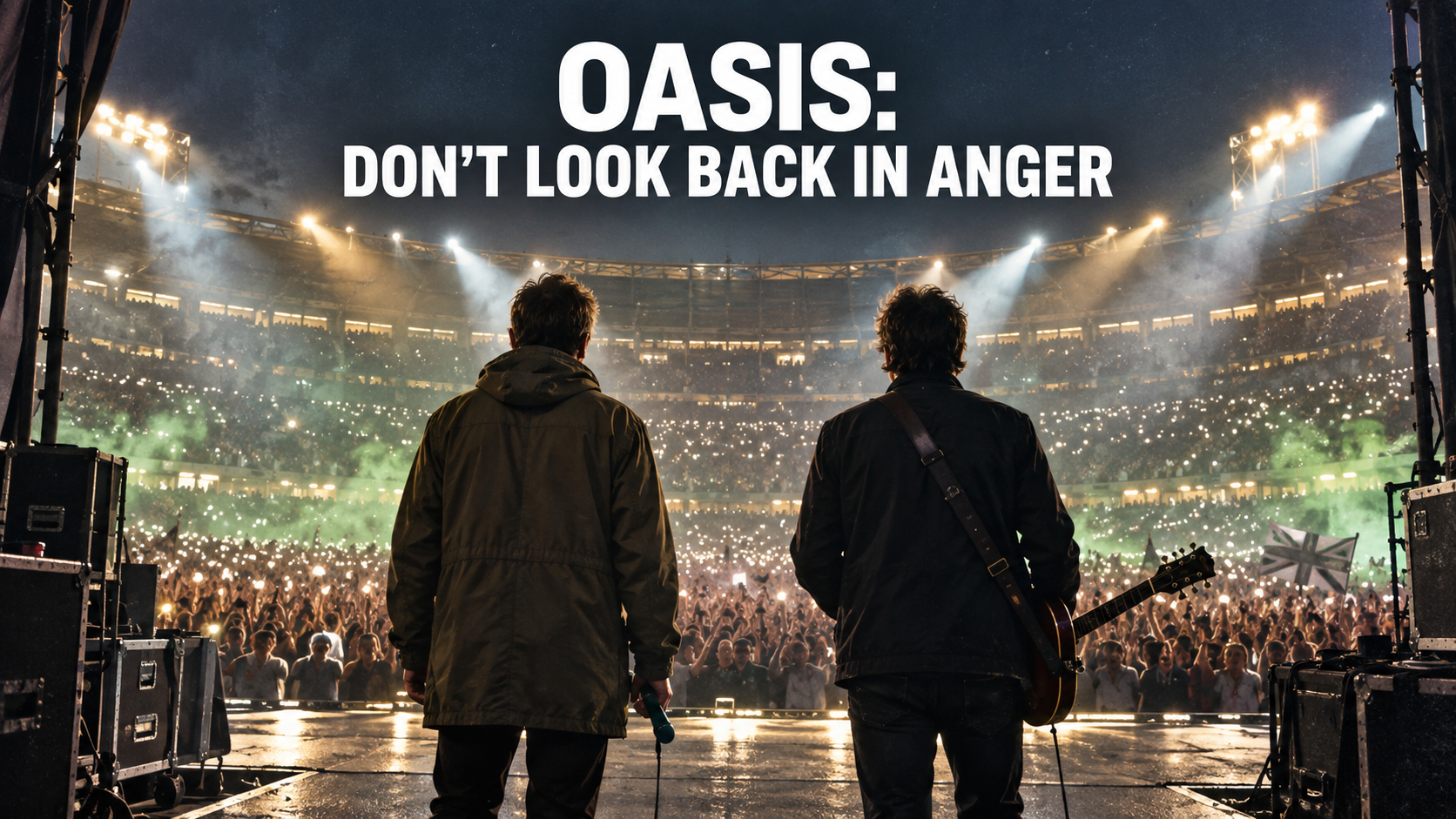
For years, an Oasis reunion seemed less likely than the Gallagher brothers politely agreeing about anything. The band’s 2009 breakup was sudden, bitter, and very public. Liam and Noel Gallagher went their separate ways, built individual careers, and spent more than a decade exchanging criticism through interviews and social media.
Then came Oasis Live ’25.
The reunion tour placed Liam and Noel on the same stage for the first time in 16 years, attracting fans from multiple generations and transforming each concert into something bigger than a nostalgic rock show. The documentary Oasis: Don’t Look Back in Anger captures that unexpected return through rehearsal footage, backstage access, stadium performances, fan stories, and rare joint interviews with the brothers.
Directed by Dylan Southern and Will Lovelace, the film is both a concert experience and a story about reconciliation. It looks at what happened when one of Britain’s most famous sibling feuds was temporarily set aside—and why Oasis songs still mean so much to people around the world.
Oasis: Don’t Look Back in Anger Quick Facts
| Detail | Information |
|---|---|
| Title | Oasis: Don’t Look Back in Anger |
| Genre | Music documentary and concert film |
| Theatrical release | September 11, 2026 |
| Venice premiere | September 5, 2026 |
| Directors | Dylan Southern and Will Lovelace |
| Created and written by | Steven Knight |
| Featured artists | Liam Gallagher, Noel Gallagher, and Oasis |
| Running time | 2 hours 4 minutes |
| Rating | R for language |
| Production company | Magna Studios |
| Presented by | Sony Music Vision |
| Streaming platforms | Disney+ internationally; Hulu and Disney+ in the U.S. |
| Streaming date | Later in 2026; exact date not announced |
Disney lists the film as an R-rated music documentary released on September 11, 2026. Its creative team includes producers Sam Bridger and Guy Heeley, cinematographer Haris Zambarloukos, and editors George Cragg and Martina Zamolo. Disney Movies
What Is Oasis: Don’t Look Back in Anger About?
Oasis: Don’t Look Back in Anger chronicles the band’s hugely anticipated Live ’25 reunion tour.
The film follows Liam and Noel Gallagher as they prepare to perform together again after years of public conflict. Viewers are taken inside rehearsals, backstage areas, private conversations, and enormous stadium concerts.
For fans, the access is important. Oasis has been extensively documented before, but the circumstances surrounding this tour were unique. Millions of people wanted to know whether the reunion would actually happen, whether the brothers could remain in the same room, and whether the band would still sound like Oasis after such a long separation.
The documentary captures those uncertainties without treating the reunion as a simple business arrangement. It explores the personal meaning of two brothers returning to the music they created together.
The film also looks beyond Liam and Noel. Fans from different countries and age groups become part of the story, showing how Oasis continued attracting new listeners even when the band was inactive.
According to its official synopsis, the documentary contains unprecedented rehearsal, backstage, and onstage access, along with the first joint interviews with Liam Gallagher and Noel Gallagher in more than 20 years. Rotten Tomatoes
The Breakup Behind the Reunion
To understand why Oasis Live ’25 became such a major cultural event, it helps to remember how the band ended.
Oasis formed in Manchester in 1991 and quickly became one of the defining groups of the Britpop era. The band’s debut album, Definitely Maybe, arrived in 1994, followed by the global breakthrough (What’s the Story) Morning Glory? in 1995.
Their songs combined huge melodies, loud guitars, confidence, and emotional directness. Tracks such as Wonderwall, Live Forever, Champagne Supernova, Supersonic, and Don’t Look Back in Anger became part of British popular culture.
But the band’s music was almost inseparable from the difficult relationship between the Gallagher brothers. Noel was the primary songwriter and lead guitarist, while Liam became the instantly recognizable voice and attitude of Oasis. Their chemistry made the band exciting, but their arguments repeatedly threatened its future.
The final collapse came in August 2009. Oasis was scheduled to perform near Paris when a backstage dispute led Noel to leave the band. The concert was canceled, and Noel announced that he could no longer work with Liam.
What followed was more than a normal band hiatus. The brothers spent years apart, occasionally discussing each other through the press but rarely suggesting that a genuine reconciliation was close.
That history created an unusual tension around the reunion. Fans were excited to hear the songs again, but many also wondered whether the tour could survive its first week.
How the Oasis Live ’25 Tour Began
The reunion was announced in August 2024, ending years of rumors.
The Oasis Live ’25 tour began at Principality Stadium in Cardiff on July 4, 2025. More than 60,000 fans attended the opening performance, and the atmosphere reflected both celebration and relief. The band had made it onto the stage, and Liam and Noel were once again performing the songs that defined their career.
The tour continued through Manchester, London, Edinburgh, Dublin, Toronto, Chicago, Los Angeles, Mexico City, Seoul, Tokyo, Melbourne, Sydney, Buenos Aires, Santiago, and São Paulo.
Oasis eventually completed 41 concerts, with the final performances taking place at São Paulo’s MorumBIS stadium in November 2025. The official tour schedule shows how the reunion expanded from a highly anticipated British comeback into a worldwide event. Oasis official website
The touring lineup included:
- Liam Gallagher on lead vocals
- Noel Gallagher on guitar and vocals
- Paul “Bonehead” Arthurs on guitar
- Gem Archer on guitar
- Andy Bell on bass
- Joey Waronker on drums
Rather than reinventing Oasis for a new era, the performances focused on the scale and directness that made the band famous. The set lists moved through songs from Definitely Maybe, (What’s the Story) Morning Glory?, Be Here Now, and later albums.
Why the Documentary Is More Than a Concert Film
A standard concert movie could simply record Oasis performing their greatest songs in front of a massive crowd. Don’t Look Back in Anger aims for something more personal.
The documentary explores three connected stories.
The first is the return of the band. Rehearsal footage shows musicians rebuilding the sound of Oasis and preparing for the pressure surrounding the tour.
The second is the changing relationship between Liam and Noel. The filmmakers interviewed them separately before rehearsals and together while the tour was underway. This structure allows the documentary to show how their relationship develops rather than presenting the reconciliation as a single magical moment.
The third story belongs to the fans. Some audience members discovered Oasis during the 1990s, while others were born after the band’s biggest albums had already been released. Their experiences help explain why demand for the tour became so intense.
The Associated Press described the movie as part concert film and part examination of the brothers’ famously difficult relationship. It also reported that the filmmakers attempted to become almost invisible during rehearsals, allowing the band’s interactions to unfold naturally. Associated Press
Liam and Noel Gallagher’s Joint Interview
One of the documentary’s biggest attractions is the extended access to Liam and Noel Gallagher together.
For many years, interviews about Oasis featured only one brother discussing the other. Their versions of the band’s history frequently contradicted each other, and even ordinary stories could become part of their ongoing feud.
Seeing them interviewed together changes the energy.
The brothers can react to the same memories in real time. Humor, discomfort, affection, and irritation can exist within the same conversation. That dynamic is central to understanding Oasis because the band was never simply a partnership between two musicians. It was a complicated family relationship played out in public.
The film does not necessarily provide a complete explanation for every argument or reveal one dramatic event that repaired the relationship. Reconciliation rarely works that neatly. Instead, it allows viewers to observe two older men attempting to move forward without pretending that the past never happened.
Why the Title Don’t Look Back in Anger Matters
The documentary takes its title from one of Oasis’s most beloved songs.
Written by Noel Gallagher and released as a single in 1996, Don’t Look Back in Anger became a defining Oasis anthem. It was also notable for featuring Noel on lead vocals rather than Liam.
The title feels particularly appropriate for a documentary about the reunion.
For years, the history of Oasis was dominated by resentment. Every reunion rumor was followed by reminders of old insults, canceled performances, damaged instruments, and disagreements over who was responsible for the breakup.
The Live ’25 tour did not erase that past, but it showed that Liam and Noel could choose not to remain trapped inside it.
“Don’t Look Back in Anger” also became much bigger than the band. It has been sung by crowds at sporting events, public gatherings, memorials, and moments of national grief. Its emotional meaning has changed as listeners have connected it to their own experiences.
That broader cultural life makes it the right title for a film interested in forgiveness, memory, and the way music continues moving after its creators stop working together.
Who Directed Oasis: Don’t Look Back in Anger?
The film was directed by Dylan Southern and Will Lovelace, a filmmaking duo with extensive experience capturing music and the personalities behind it.
Their earlier credits include Shut Up and Play the Hits, which documented LCD Soundsystem’s farewell concert, and Meet Me in the Bathroom, an exploration of New York’s early-2000s music scene.
Those projects demonstrated their ability to combine live performance with cultural context. They understand that a music documentary needs more than famous songs. It needs to capture why those songs mattered at a specific moment.
The documentary was created and written by Steven Knight, best known as the creator of Peaky Blinders. Knight has also written films such as Eastern Promises, Spencer, and Dirty Pretty Things.
Knight reportedly wanted the film to investigate why Oasis remained important to listeners who experienced the band in the 1990s and to younger fans who discovered the music during the group’s long absence.
That question gives the documentary a stronger purpose than simply announcing that Oasis is back.
The Importance of Seeing It in IMAX
Oasis: Don’t Look Back in Anger was designed for cinemas and received an IMAX release.
That format makes sense for a film built around stadium concerts. Oasis songs depend on scale: loud guitars, enormous choruses, and thousands of voices singing together. A television can reproduce the music, but a large screen and powerful theater sound system can better communicate the physical feeling of being inside the crowd.
The technical team includes Oscar-winning sound mixers James Mather, known for Top Gun: Maverick and Belfast, and Tarn Willers, whose credits include The Zone of Interest. Cinematographer Haris Zambarloukos previously worked on visually ambitious films including Belfast and A Haunting in Venice.
Their involvement suggests that the concert footage was treated as cinema rather than ordinary tour documentation.
The most effective sequences are likely to be the mass sing-alongs. During these moments, the audience is not simply watching Oasis. The crowd becomes part of the performance, creating the communal energy that made the reunion such a powerful experience.
What Songs Appear in the Film?
The Oasis documentary soundtrack draws from the music performed during Live ’25.
The tour’s set list included many of the band’s biggest and most emotionally important songs:
- Hello
- Acquiesce
- Morning Glory
- Some Might Say
- Supersonic
- Cigarettes & Alcohol
- Talk Tonight
- Half the World Away
- Stand by Me
- Slide Away
- Live Forever
- Rock ’n’ Roll Star
- The Masterplan
- Don’t Look Back in Anger
- Wonderwall
- Champagne Supernova
Not every song needs to appear in full for the film to capture the tour’s musical journey. Some performances establish the band’s swagger, while others reveal the emotional connection between Oasis and its audience.
Songs such as “Live Forever” and “Don’t Look Back in Anger” have naturally taken on new meaning. They are no longer only recordings from the 1990s; they now represent the survival and return of a band many listeners believed they would never see again.
Critical and Audience Reception
Early responses to Oasis: Don’t Look Back in Anger have been highly positive.
As of September 12, 2026, Rotten Tomatoes lists the documentary with a 96% critics’ score and a 98% verified audience score. Because these figures can change as more reviews arrive, they should be viewed as a snapshot of its opening reception rather than permanent ratings.
Critics have particularly praised the concert sequences, emotional fan stories, and the sight of the Gallagher brothers sharing a stage again.
The main criticism is that the film sometimes celebrates the reunion more than it investigates it. Some reviewers wanted a deeper examination of what caused the original breakup or exactly how the brothers repaired their relationship.
That limitation may matter more to viewers seeking a confrontational documentary. Fans primarily interested in the music, tour, and emotional power of the comeback are likely to find plenty to enjoy.
When Will Oasis: Don’t Look Back in Anger Stream?
Oasis: Don’t Look Back in Anger is currently playing in cinemas and IMAX.
The film will stream internationally on Disney+ later in 2026. In the United States, it will be available through both Hulu and Disney+.
An exact streaming date has not yet been announced. The official Oasis website confirms the platforms and the planned 2026 streaming window. Oasis
The documentary is not expected to stream on Netflix because Disney holds the streaming distribution rights.
Why the Oasis Documentary Matters
Oasis: Don’t Look Back in Anger works because the reunion represents more than another successful stadium tour.
It is a story about unfinished relationships, the passing of time, and music that remained alive while the people who created it refused to speak to each other. Liam and Noel did not return as the same young men who fought their way through the 1990s. Their audience changed too.
Some fans entered the stadium remembering exactly where they were when Definitely Maybe arrived. Others discovered “Wonderwall” through streaming playlists, social media, or their parents’ record collections. For one night, those generations stood together and sang the same songs.
The documentary preserves that moment while asking why it carried so much emotional weight. It does not need to prove that every wound between the Gallagher brothers has healed. The fact that they managed to share the journey at all is what makes the story worth watching.
For longtime followers, the film offers access to a reunion they spent years believing would never happen. For newer listeners, it explains why Oasis remains one of the most discussed and emotionally powerful British bands of the modern era.