
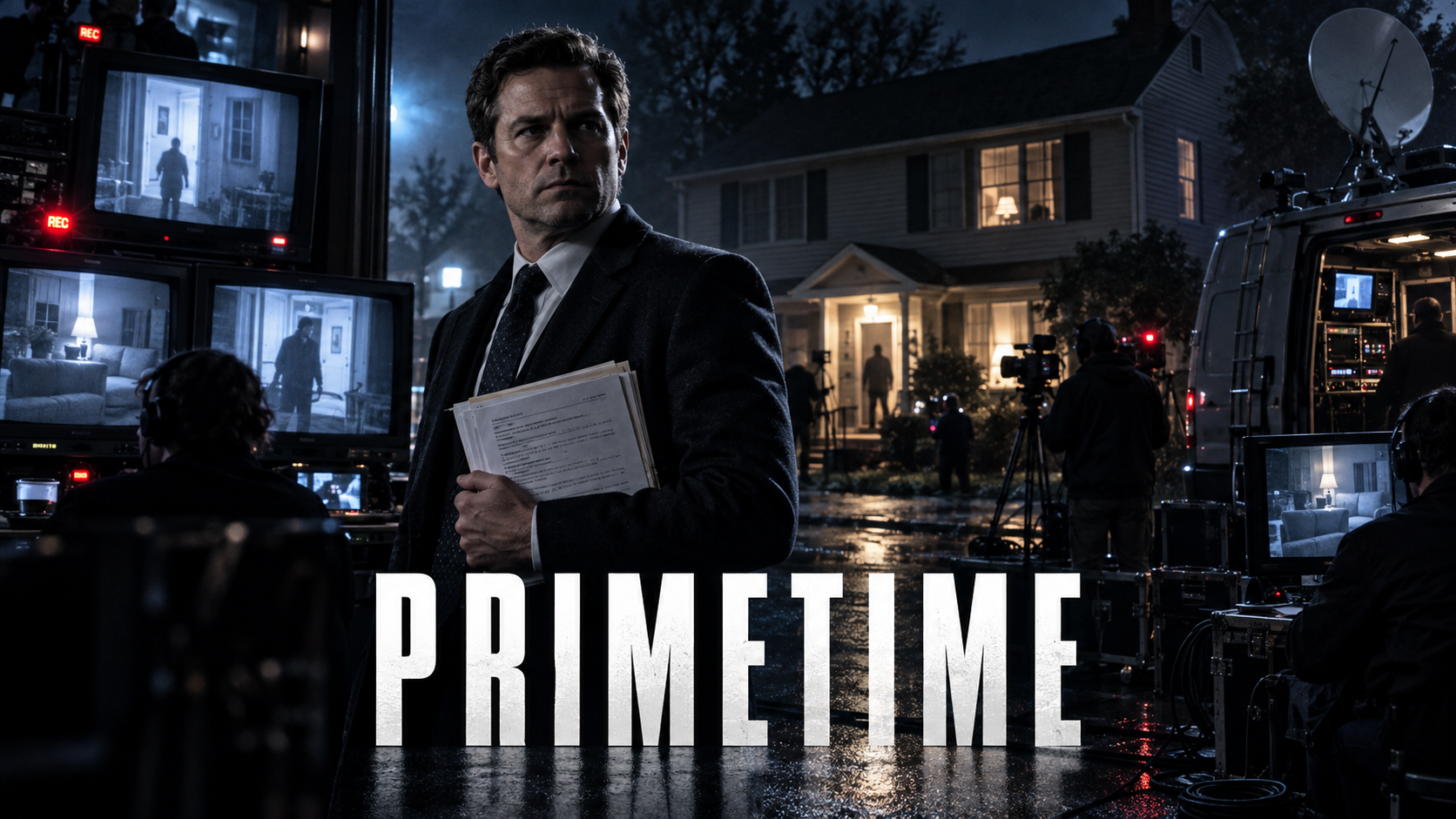
Primetime turns one of the most controversial chapters in American reality television into a dark psychological crime thriller. Directed by documentary filmmaker Lance Oppenheim, the A24 movie stars Robert Pattinson as Chris Hansen, the television journalist who became famous for confronting suspected online predators on NBC’s To Catch a Predator.
Rather than approaching the subject as a straightforward biographical drama, the film examines what happens when journalism, justice, ambition, ratings, and entertainment become dangerously difficult to separate. It takes viewers behind the television cameras and asks uncomfortable questions about the people making the program, the audience watching it, and the institutions benefiting from its popularity.
Set primarily in 2006, Primetime follows Hansen and his production team as they attempt to create a historic piece of television. Their sting operation initially appears to offer a clear battle between good and evil. As the production becomes more ambitious, however, ethical boundaries begin to disappear.
The film had its world premiere at the 2026 Venice International Film Festival and is scheduled to arrive in U.S. theaters on September 25, 2026.
Primetime Movie Details
- Title: Primetime
- Release date: September 25, 2026
- Director: Lance Oppenheim
- Screenwriter: Ajon Singh
- Distributor: A24
- Main star: Robert Pattinson
- Genre: Psychological crime thriller and media satire
- Running time: 1 hour and 50 minutes
- Rating: R
- World premiere: 2026 Venice International Film Festival
- Production companies: A24, Square Peg, Icki Eneo Arlo, and Range Media Partners
A24’s official Primetime page confirms the theatrical release date, director, leading cast, and the film’s 2006 setting.
What Is Primetime About?
Primetime follows Chris Hansen during the height of To Catch a Predator, a recurring segment produced for NBC’s Dateline. The real program used adult decoys posing as minors in online conversations. When men arrived at a designated house expecting to meet those minors, Hansen confronted them in front of hidden television cameras.
The encounters frequently ended with law-enforcement officers waiting outside.
In the movie, Hansen is presented as an ambitious journalist determined to create a television event audiences will not be able to ignore. His team builds a sting operation using online conversations, hidden cameras, performers, police involvement, and a carefully controlled house.
The format initially looks simple. A suspect arrives, Hansen walks into the room, and the cameras capture the confrontation. Behind that familiar structure, however, lies a complicated operation involving producers, decoys, lawyers, television executives, and law-enforcement officials.
As ratings rise, the program becomes more aggressive. The desire to expose wrongdoing slowly mixes with the desire to create dramatic television. Every confrontation must be more shocking than the last, and Hansen faces pressure to deliver a bigger story.
The situation reaches a crisis when the team focuses on a powerful target who does not follow the expected script. What began as a television investigation becomes a disturbing examination of ambition, public punishment, and the consequences of turning real lives into entertainment.
Is Primetime Based on a True Story?
Primetime is inspired by real events, but it is not a documentary or a completely factual recreation.
Chris Hansen is a real journalist, and To Catch a Predator was a real television program. The movie uses Hansen’s name and recreates the recognizable structure of the show, but several characters, conversations, and behind-the-scenes events have been fictionalized.
The film is loosely connected to the 2007 Esquire article “Tonight on Dateline This Man Will Die.” Written by Luke Dittrich, the article examined a controversial 2006 sting operation involving Bill Conradt, a Texas prosecutor.
Conradt did not arrive at the house being used for the television operation. Police officers and television personnel later went to his home, where he died by suicide. The incident led to serious questions about journalistic ethics, police procedure, television sensationalism, and the relationship between NBC and the private watchdog group working with the program.
Primetime uses that history as the foundation for a broader story about the machinery behind reality television. It is less interested in reproducing every event exactly than in exploring how a production built around public exposure could become a cultural phenomenon.
The film should therefore be viewed as a fictionalized true-crime drama, not as an authoritative account of Hansen’s career or the complete history of To Catch a Predator.
Robert Pattinson as Chris Hansen
Robert Pattinson plays a stylized and fictionalized version of Chris Hansen. It is another unconventional role for an actor who has repeatedly moved between major studio productions and challenging independent films.
Pattinson reportedly studied Hansen’s television appearances, interviews, and podcast conversations while preparing for the part. Hansen’s controlled delivery was particularly important. His voice on To Catch a Predator sounded calm and professional, even when he was confronting people in extremely tense circumstances.
Instead of delivering a simple impersonation, Pattinson exaggerates certain qualities to reveal the character’s ambition. His version of Hansen is polished in front of the camera but far less controlled when the broadcast is threatened. He understands that his success depends on appearing calm, moral, and authoritative, even while the production around him grows increasingly chaotic.
Director Lance Oppenheim described the character in unusually theatrical terms, comparing the performance to a combination of an ambitious salesman and a gothic predator. That contrast appears central to the movie. Hansen sees himself as the hunter, but his hunger for attention may also be consuming him.
Early reviews have repeatedly identified Pattinson’s performance as the film’s greatest strength. Critics have praised his physical transformation, unusual vocal work, and ability to make Hansen charismatic, unsettling, funny, and difficult to understand at the same time.
The Cast of Primetime
Robert Pattinson as Chris Hansen
Pattinson plays the television journalist at the center of the story. He also serves as one of the film’s producers through his company, Icki Eneo Arlo.
Merritt Wever as Andie Bender
Merritt Wever plays Andie Bender, a Dateline producer closely involved with Hansen’s investigations. The character represents the commercial pressures surrounding the program and the belief that successful television must constantly become bigger and more dramatic.
Andie is not simply a background executive. She helps shape what the audience sees and understands how easily public interest can be converted into ratings.
Skyler Gisondo as Dan Plumb
Skyler Gisondo appears as Dan Plumb, a young aspiring actor hired to participate in the sting operations.
His character is partly inspired by the performers who worked as decoys during the real program. Dan begins close enough to the production to understand how it operates, but he is not powerful enough to control what happens.
His position allows the film to examine the emotional cost placed on young workers who are asked to help manufacture convincing—and potentially dangerous—situations for television.
Phoebe Bridgers as Del Harvey
Singer-songwriter Phoebe Bridgers plays Del Harvey, another young member of Hansen’s team who works as a decoy. The role marks Bridgers’ major dramatic feature-film debut after previous screen appearances connected to her music and as herself.
Del helps create the online identities used during the operation. Her work highlights the uncomfortable mixture of performance and reality at the heart of the program.
Matthew Maher
Matthew Maher plays Xavier von Erck, a figure associated with the organization assisting the sting operation. His character reflects the involvement of private online investigators who communicated with suspects before the televised confrontations.
Bokeem Woodbine
Bokeem Woodbine appears in a supporting role. The experienced actor brings additional weight to the film’s law-enforcement and investigative world.
The wider cast includes Anna Faris, Tony Revolori, Jonathan Lipnicki, Sean Bridgers, Jessica Hecht, Bill Heck, Alex Winter, and former television executive Jeff Zucker.
A24 lists Pattinson, Wever, Gisondo, Bridgers, Maher, and Woodbine as the film’s principal ensemble on its official cast page.
Lance Oppenheim Makes His Narrative Feature Debut
Primetime is the first scripted feature directed by Lance Oppenheim, but his documentary background makes him an unusually appropriate choice.
Oppenheim previously directed projects including Some Kind of Heaven, Spermworld, and the documentary series Ren Faire. His work frequently examines people living inside unusual communities or carefully constructed versions of reality.
That interest naturally connects to To Catch a Predator. Although the television program presented itself as journalism, it also depended on sets, performers, hidden cameras, dramatic entrances, and carefully edited confrontations.
Oppenheim approaches Primetime as both a crime story and a show-business story. The movie is interested in the construction of television: how a room is lit, where cameras are hidden, how a confrontation is prepared, and how a producer turns unpredictable behavior into a clear narrative.
The screenplay was written by Ajon Singh, while the producing team includes Robert Pattinson and filmmaker Ari Aster. Aster’s production company, Square Peg, is known for psychologically intense movies, making its involvement a natural fit for the film’s unsettling tone.
Why Primetime Looks More Like a Horror Movie
Although it is classified as a drama and thriller, Primetime reportedly uses the visual language of horror.
The sting house becomes a trap filled with hidden observers. Computer screens glow in dark rooms, cameras quietly record every movement, and ordinary suburban spaces begin to feel threatening. Hansen’s calm arrival creates suspense because viewers know that the person sitting across from him has suddenly lost control of the situation.
The movie also uses bright television lighting and dark backstage spaces to create a contrast between public morality and private ambition.
Some critics have compared its media satire to films such as Nightcrawler and Network. Like those movies, Primetime explores an industry that claims to document reality while constantly reshaping reality into something more dramatic and profitable.
The R rating reflects the film’s adult subject matter. Rotten Tomatoes lists the classification reasons as disturbing sexual material, graphic nudity, language, and some violent content. It is not a conventional action movie, and its disturbing material comes largely from the subject being investigated.
The Meaning Behind the Primetime Title
“Primetime” refers to the evening hours when television networks traditionally attract their largest audiences and sell their most valuable advertising.
For Hansen and his production team, reaching primetime means more than receiving a better time slot. It represents legitimacy, influence, fame, and commercial power.
The title also captures the contradiction at the center of the story. The program deals with disturbing criminal behavior, but that behavior is packaged into television designed to hold an audience’s attention.
Every successful confrontation makes the production more valuable. That creates an uncomfortable question: Can a television team remain focused entirely on justice when its professional success depends on producing increasingly dramatic encounters?
The film does not appear interested in offering a simple answer. Instead, it places viewers inside the production process and allows the discomfort to build.
Media Ethics and the Attraction of Public Punishment
The central subject of Primetime is not whether adults attempting to meet minors should be investigated. The film’s more difficult questions concern who should conduct those investigations and how they should be presented to the public.
The television operation combines several different goals:
- Journalists want an important story.
- Producers want compelling footage.
- Networks want strong ratings.
- Police want evidence that can support arrests.
- Private investigators want to expose offenders.
- Audiences want to see guilty people confronted.
Those goals can overlap, but they are not identical.
A law-enforcement investigation must follow legal procedures. A television program, by contrast, is structured around compelling images and dramatic moments. When the two systems work together, the need for evidence can become mixed with the need for entertainment.
The audience is part of that system as well. Millions of viewers watched the confrontations because they were shocking and emotionally satisfying. Primetime appears determined to make viewers question that satisfaction without minimizing the seriousness of the alleged behavior being exposed.
Chris Hansen’s Response to Primetime
The real Chris Hansen has publicly criticized the film and its portrayal of his work.
Hansen has said he was not consulted during production and believes the movie transforms a serious journalistic investigation into an unnecessarily dark story. He has also disputed elements shown in promotional material, arguing that several scenes do not reflect events as they actually occurred.
His criticism reinforces an essential point: Primetime is a dramatization, and Robert Pattinson’s character should not be treated as a perfectly accurate representation of the real journalist.
Hansen has said that he does not blame Pattinson personally and considers him a talented performer. His objections are mainly directed toward the filmmakers’ creative choices and the way the production presents his work.
The dispute has become part of the conversation surrounding the movie. People’s report on Hansen’s reaction explains that he was not involved in developing the project and strongly disagrees with its direction.
Primetime Reviews and Early Reception
Primetime received substantial attention following its Venice Film Festival premiere.
As of September 14, 2026, Rotten Tomatoes lists the movie with a 94% critics’ score from 33 reviews. That number may change as more reviews are published after the theatrical release.
Positive reviews have praised Robert Pattinson’s performance, the ominous cinematography, and the film’s uncomfortable exploration of media ambition. Several critics have also highlighted Skyler Gisondo and Merritt Wever for giving the story a more grounded emotional perspective.
Not every response has been enthusiastic. Some reviewers believe the movie creates a powerful atmosphere without reaching a clear position on Hansen, television ethics, or the sting operation itself. Others see that uncertainty as intentional, arguing that the film wants audiences to sit with unresolved moral questions.
Current ratings and review excerpts can be found on Rotten Tomatoes.
When Does Primetime Come Out?
Primetime is scheduled to open in U.S. theaters on September 25, 2026. A24 is distributing the film.
The UK theatrical release is expected on October 30, 2026. Release schedules in other countries may differ, so international viewers should check local cinema listings.
No universal subscription-streaming date has been announced. Like many A24 releases, the film is expected to receive a digital rental and purchase window after its theatrical run, followed by a later streaming release.
Is Primetime Worth Watching?
Primetime looks best suited to viewers who enjoy true-crime dramas, morally complicated thrillers, media satires, and unconventional Robert Pattinson performances.
Anyone expecting a traditional Chris Hansen biography may be surprised. The film uses real names and recognizable events, but it is more interested in atmosphere, power, and ethical uncertainty than in producing a complete history of To Catch a Predator.
Its subject matter is deliberately uncomfortable. The movie examines alleged sexual crimes involving minors, public humiliation, suicide, and the commercial incentives behind sensational television. It is therefore not casual entertainment despite its moments of dark humor.
For viewers interested in how television changes the events it records, Primetime offers a provocative idea: the camera does not simply observe the story. Its presence can influence everyone in the room.
With Robert Pattinson’s unsettling transformation, Lance Oppenheim’s documentary-trained eye, and A24’s taste for psychologically challenging cinema, Primetime has become one of 2026’s most discussed crime thrillers before reaching general audiences. Whether viewers see it as a sharp criticism of reality television or an intentionally troubling dramatization, it is unlikely to leave them feeling neutral.