
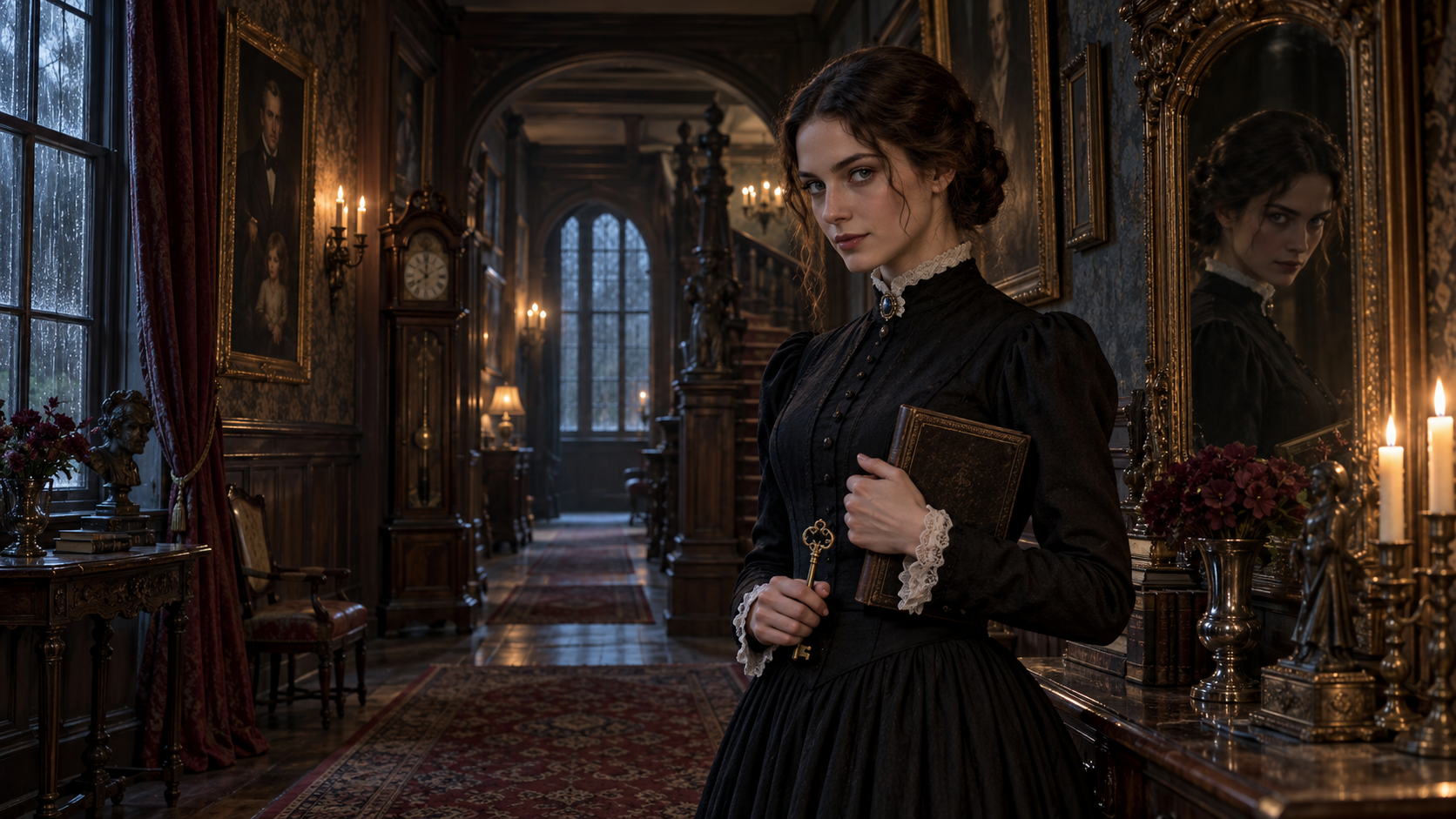
Elegant dresses, strict manners, candlelit corridors, and a homicidal governess come together in Victorian Psycho, one of 2026’s most unusual horror releases.
Directed by Zachary Wigon and adapted from Virginia Feito’s acclaimed novel, the movie stars Maika Monroe as Winifred Notty, an eccentric young governess who accepts a position at a remote English estate in 1858. Her employers expect her to educate their children and teach them proper behavior. Unfortunately for everyone living in the house, Winifred is hiding extremely violent impulses beneath her carefully controlled appearance.
Victorian Psycho blends gothic horror, psychological thriller, period drama, pitch-black comedy, and social satire. Instead of presenting its killer as a mysterious figure whose identity must be discovered, the story places viewers directly inside Winifred’s disturbing mind.
The movie premiered at the 2026 Cannes Film Festival, where Maika Monroe’s unpredictable performance became its most widely discussed feature. Following its festival debut, the film is heading to theaters through Bleecker Street.
Victorian Psycho Movie Details
- Movie title: Victorian Psycho
- Current U.S. release date: November 13, 2026
- Genre: Gothic horror, psychological thriller, and dark comedy
- Director: Zachary Wigon
- Screenwriter: Virginia Feito
- Based on: Victorian Psycho by Virginia Feito
- Main star: Maika Monroe
- Setting: Victorian England in 1858
- Primary location: Ensor House
- U.S. distributor: Bleecker Street
- Rating: R
- Countries of production: United Kingdom and Ireland
The film was initially promoted with a September 25 release date, but its U.S. opening was later moved to November 13, 2026. Current listings from Rotten Tomatoes and major theater chains now reflect the November date, while the official Bleecker Street page describes it more generally as arriving in theaters during the fall.
What Is Victorian Psycho About?
The story begins in 1858 when Winifred Notty arrives at Ensor House, a remote gothic manor in the English countryside. She has been hired by Mr. and Mrs. Pounds to work as governess to their two children, Andrew and Drusilla.
Winifred’s responsibilities sound perfectly respectable. She is expected to teach the children table manners, introduce them to the history of their family, supervise their education, and prepare them for their future position in society.
Winifred, however, is not a respectable Victorian governess.
Behind her controlled voice and formal clothing is a woman with violent fantasies, a mysterious past, and very little interest in following the rules imposed on her. Her thoughts move between sharp social observations, disturbing memories, resentment, and elaborate visions of cruelty.
As she settles into Ensor House, members of the household staff begin disappearing. Strange incidents become increasingly difficult for the Pounds family to ignore, yet the estate’s rigid social structure prevents its residents from immediately understanding the danger standing in front of them.
The official Cannes Film Festival synopsis describes Winifred as someone living “on the border between insurrection and madness.” That description captures the movie’s central tension. Winifred is clearly dangerous, but she is also trapped inside a society determined to control women, servants, children, and anyone without social power.
Who Is Winifred Notty?
Winifred Notty is both the protagonist and the primary threat in Victorian Psycho.
She is not designed as a conventional heroine. The story does not hide or excuse her capacity for cruelty. Viewers understand early that something is deeply wrong with her, and the suspense comes from wondering what she will do next.
At the same time, Winifred is intelligent enough to recognize the absurdity of the world around her. Victorian society demands perfect manners while allowing wealthy people to mistreat those beneath them. Women are expected to remain quiet, obedient, attractive, and emotionally controlled regardless of what they experience.
Winifred sees those contradictions, but her response is not healthy rebellion. She turns resentment into increasingly extreme behavior.
That combination makes her difficult to categorize. She can be perceptive, funny, horrifying, childish, and completely unpredictable within the same scene. The audience may understand some of her anger without approving of how she expresses it.
The title deliberately recalls American Psycho, and the two stories share several features. Both follow an unreliable killer who performs an acceptable social identity while privately describing violent compulsions. Both also use dark comedy to expose the hypocrisy of their respective eras.
Winifred is not simply a Victorian version of Patrick Bateman, however. Her position as a governess places her between social classes. She lives inside the wealthy family’s home but is never truly part of it. She possesses authority over the children while remaining economically dependent on their parents.
That uncomfortable position provides ideal material for a gothic psychological horror story.
Maika Monroe as Winifred Notty
Maika Monroe plays Winifred in a performance that is noticeably different from her earlier horror roles.
Monroe became a modern genre favorite through movies such as It Follows, Watcher, and Longlegs. In many of those films, she played quiet, inward-looking characters attempting to understand a threat around them.
Victorian Psycho reverses that dynamic. This time, Monroe is not running from the danger. She is the danger.
Winifred is loud, theatrical, emotionally exaggerated, and physically expressive. Rather than suppressing her instability, she frequently appears delighted by it. Monroe has explained that preparing for the part involved extensive rehearsals, dialect work, prosthetic teeth, a wig, and studying performances such as Jack Nicholson’s work in The Shining.
In an interview with the Associated Press, Monroe described the role as a departure from the controlled characters for which she is best known. The film gives her an opportunity to combine horror with broad, uncomfortable comedy.
Early reviews have largely agreed that her performance is the movie’s main attraction. Even critics who were less enthusiastic about the overall story praised the energy and commitment she brings to Winifred.
Victorian Psycho Cast and Characters
The confirmed cast includes:
- Maika Monroe as Winifred Notty: The newly hired governess whose polite appearance conceals violent impulses.
- Jason Isaacs as Mr. Pounds: The stern owner of Ensor House and father of Winifred’s young students.
- Ruth Wilson as Mrs. Pounds: The lady of the estate, whose household begins falling apart after Winifred arrives.
- Thomasin McKenzie as Ms. Lamb: A character connected to the manor and Winifred’s increasingly unstable experience.
- Jacobi Jupe as Andrew Pounds: One of the children placed under Winifred’s supervision.
- Evie Templeton as Drusilla Pounds: Andrew’s sister and Winifred’s other student.
- Amy De Bhrún as Mrs. Fancey: A member of the Ensor House staff.
- Katherine Moran as Marigold: Another supporting character within the household.
- Kate Brady as Amelia: A resident or employee connected to the estate.
The supporting actors are particularly well suited to the film’s darkly comic tone. Jason Isaacs and Ruth Wilson have both played cold, authoritative, and morally complicated characters in previous projects, making them natural choices for the owners of an oppressive Victorian household.
Thomasin McKenzie also brings previous experience with period stories and psychological thrillers, including Last Night in Soho and Eileen.
Is Victorian Psycho Based on a Book?
The movie is based on Virginia Feito’s 2025 novel of the same name.
Published in the United States by Liveright, the short horror novel is narrated by Winifred Notty. It follows her arrival at Ensor House and gradually reveals the full extent of her instability.
The book combines the atmosphere of classic gothic fiction with modern psychological horror. Its influences include Victorian novels about governesses, isolated country houses, neglected children, class resentment, and women trapped by social expectations.
However, readers expecting a traditional slow-moving period drama may be surprised by the novel’s graphic violence, grotesque imagery, and deliberately uncomfortable humor.
Feito previously wrote Mrs. March, another psychological novel centered on an unreliable woman whose understanding of reality becomes increasingly unstable. With Victorian Psycho, she pushes those interests into more openly violent and satirical territory.
Most importantly, Feito adapted her own novel for the screen. That means the screenplay comes from the writer who created Winifred rather than from someone attempting to imitate her unusual voice.
Because a novel can remain inside a narrator’s mind more easily than a film, the adaptation uses voiceover, visual fantasy, editing, and Monroe’s performance to communicate Winifred’s thoughts. The movie does not reproduce every page exactly, but it attempts to preserve the book’s mixture of elegance, disgust, humor, and rage.
Who Directed Victorian Psycho?
Victorian Psycho was directed by Zachary Wigon, best known for the 2022 psychological thriller Sanctuary.
That film focused on a complicated power struggle between two characters inside a confined space. It relied heavily on shifting control, manipulation, performance, and dark humor rather than traditional action.
Those interests make Wigon a strong match for Victorian Psycho. Ensor House functions almost like a sealed psychological arena. Every conversation is shaped by status, gender, employment, and social expectations.
Wigon does not treat the period setting as a museum display. The carefully decorated rooms, formal costumes, candlelight, and table manners create a surface of respectability that Winifred repeatedly disrupts.
The movie’s visual style reportedly emphasizes symmetrical rooms, elaborate production design, controlled camera movements, and sudden bursts of disorder. The more unstable Winifred becomes, the less reliable the world around her appears.
What Happened to Margaret Qualley and A24?
The movie went through several major changes before production began.
Margaret Qualley was originally announced as Winifred Notty in October 2024. A24 later acquired U.S. distribution rights, and filming was expected to begin in early 2025.
Those plans changed when Qualley left the project. A24 also stepped away, leaving the production to seek a new lead actor and U.S. distributor.
In May 2025, Maika Monroe joined the film as Winifred. Jason Isaacs was added to the cast shortly afterward. Bleecker Street eventually acquired the U.S. distribution rights, while True Brit Entertainment took the United Kingdom and Ireland.
Principal photography began in Ireland in August 2025. The country’s historic houses, landscapes, and castles provided the production with suitable locations for Ensor House and its surrounding grounds.
The finished film was produced through companies including Anton, Traffic, and Anonymous Content.
Victorian Psycho at the Cannes Film Festival
Victorian Psycho had its world premiere on May 21, 2026, in the Un Certain Regard section of the Cannes Film Festival.
Un Certain Regard traditionally highlights films with distinctive storytelling styles, emerging creative voices, or unconventional approaches to familiar genres. The selection gave Victorian Psycho an international platform months before its wider theatrical release.
The movie did not leave Cannes with unanimous praise, but the response was generally positive. Its current Rotten Tomatoes listing shows a 77% critics’ score based on 26 reviews, though that figure may change as more reviews are published closer to the theatrical opening.
Supportive reviews praised:
- Maika Monroe’s fearless and darkly funny performance
- The elaborate gothic production design
- The film’s balance of comedy and horror
- Its criticism of Victorian class and gender expectations
- Zachary Wigon’s energetic direction
- Virginia Feito’s unusual central character
More critical responses argued that:
- The movie begins at such an extreme level that it has limited room to escalate
- Some of the social commentary is too direct
- The narrative can feel episodic
- The tonal mixture of comedy and brutality will not work for everyone
That divided reaction may be appropriate for a film designed to provoke discomfort. Victorian Psycho does not appear interested in being tasteful, restrained, or universally appealing.
Is Victorian Psycho Scary?
Victorian Psycho is horror, but it does not rely only on ghosts, demons, or traditional jump scares.
Its horror comes from being trapped inside Winifred’s mind, never knowing when a social interaction will become violent. The tension is heightened by the contrast between proper Victorian behavior and the brutality hidden beneath it.
The movie also contains strong bloody violence. Its R rating was issued for strong bloody violence and brief sexual material, so it is not intended for children or younger family audiences.
People who enjoy atmospheric haunted-house stories may appreciate the isolated mansion, dark corridors, winter setting, and unsettling household. Viewers looking for serious psychological horror should know that the film also embraces exaggerated behavior and macabre comedy.
Its closest tonal relatives may include American Psycho, The Favourite, The Innocents, Pearl, and The Housemaid, though Victorian Psycho maintains its own deliberately strange personality.
How Long Is Victorian Psycho?
The Cannes Film Festival catalog lists Victorian Psycho with a runtime of 90 minutes. Some newer U.S. listings, including Rotten Tomatoes, show a runtime of approximately one hour and 42 minutes.
This difference may reflect an updated theatrical cut or incomplete listing information. Viewers should check their local theater’s schedule when tickets become available.
When Is Victorian Psycho Coming Out?
The current U.S. theatrical release date for Victorian Psycho is November 13, 2026.
Earlier announcements and trailers listed September 25, but the movie was subsequently moved to November. The change places it closer to the holiday period, an interesting choice considering the story’s dark winter atmosphere and the novel’s disturbing use of Christmas imagery.
A confirmed streaming date has not been announced. Because Bleecker Street is releasing the movie theatrically, it should first play in cinemas before becoming available through digital rental, purchase, or a future streaming agreement.
Why Victorian Psycho Stands Out
Victorian Psycho arrives during a strong period for female-led psychological horror, but its central character is different from the sympathetic women usually found in these stories.
Winifred is not simply misunderstood, possessed, or pushed into violence by one terrible event. She enters the story already dangerous. The movie allows her to criticize a cruel social system without pretending that every action she takes is justified.
That moral discomfort is part of the attraction.
The film also turns the familiar Victorian governess story upside down. Classic literature often presents a governess as a vulnerable young woman entering a mysterious household. In Victorian Psycho, the wealthy family believes it has hired someone powerless. It slowly discovers that it has invited the greatest threat directly into its home.
With Maika Monroe’s committed performance, Virginia Feito’s sharp screenplay, Zachary Wigon’s stylized direction, and a strong supporting cast, Victorian Psycho promises a deliberately excessive mixture of manners, madness, class resentment, and bloodshed.
It may be too violent for period-drama audiences and too absurd for viewers expecting completely serious horror. For fans of bold, strange, and darkly comic cinema, however, Victorian Psycho could become one of 2026’s most memorable gothic releases.