
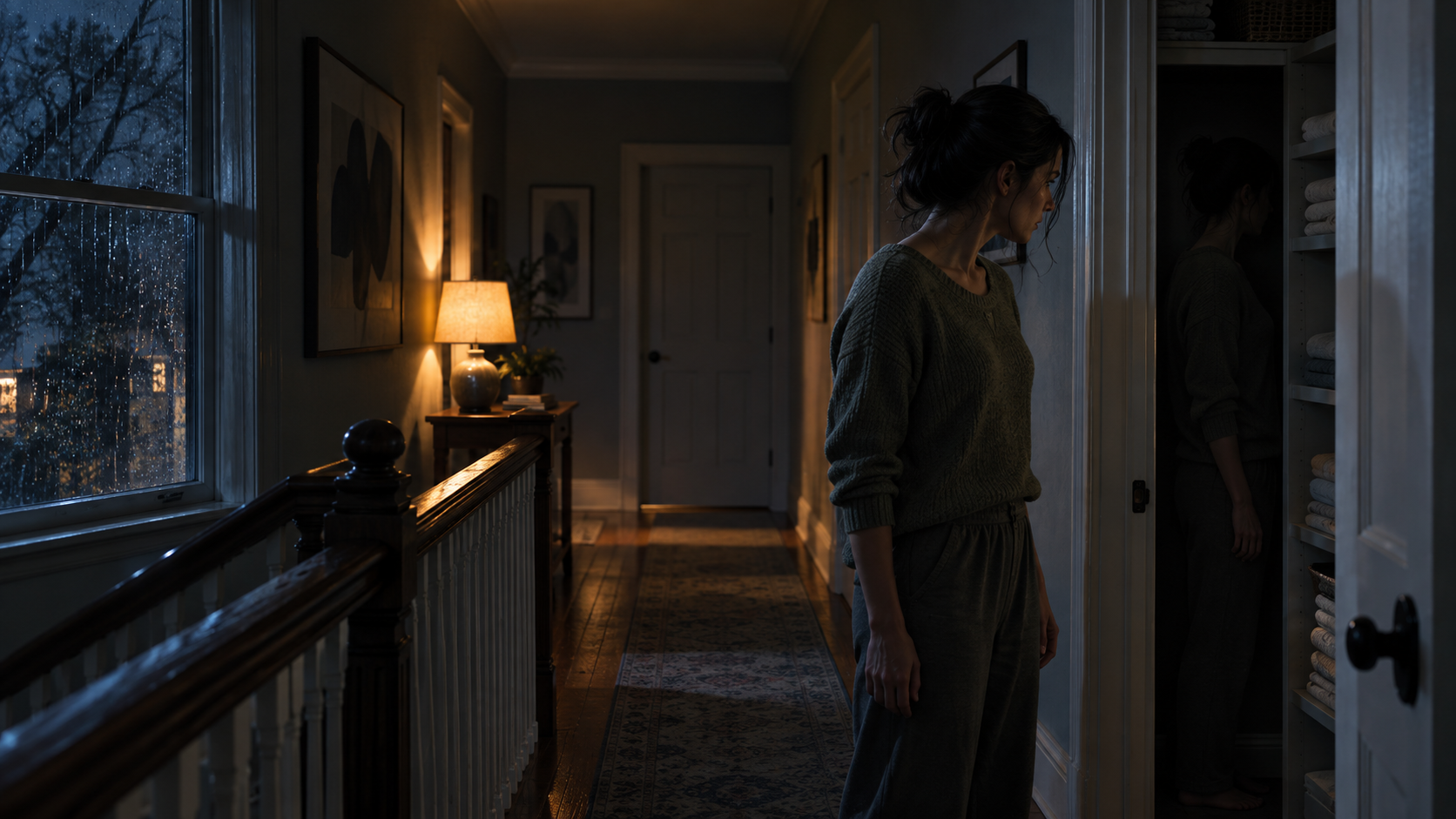
A child wakes in the darkness and discovers that someone is hiding inside her closet. The figure looks like her mother, speaks to her gently, and asks a frightening question: “Can I go inside your heart?”
That unsettling idea forms the foundation of Other Mommy, a supernatural psychological horror film starring Jessica Chastain. Directed by Rob Savage, the movie is based on Josh Malerman’s acclaimed novel Incidents Around the House and follows a young girl whose troubled home becomes the hunting ground of an increasingly powerful entity.
Rather than appearing as an obviously inhuman monster, the creature adopts the appearance of the person the child should trust most. That choice transforms a familiar childhood fear into something more disturbing. The danger does not merely live in the closet—it looks like family.
Scheduled to arrive in theaters during the Halloween season, Other Mommy combines child-centered horror, domestic tension, doppelgänger terror, and an unusually physical dual performance from Chastain.
What Is Other Mommy About?
Other Mommy centers on Bela, an eight-year-old girl living with her parents, Ursula and Russ.
Bela calls her parents Mommy and Daddo. Her family is the center of her world, but that world is already showing signs of instability. Ursula and Russ are dealing with problems in their marriage that Bela may not fully understand, even though she can sense the tension surrounding them.
Bela also has a secret visitor.
A strange being appears in the house, frequently emerging from the darkness of Bela’s bedroom closet. The child calls the entity Other Mommy because it begins to resemble Ursula.
Other Mommy asks Bela for permission to enter her heart. At first, the question may sound like an invitation to friendship. Its repetition soon makes the creature’s true intentions feel much more threatening.
As Bela continues refusing, Other Mommy becomes bolder. The haunting spreads beyond the closet, and increasingly dangerous incidents begin affecting the entire family. Ursula and Russ must protect their daughter while confronting the cracks within their own relationship.
The official premise of Josh Malerman’s novel describes Other Mommy as a malevolent entity that repeatedly asks Bela for permission to enter her heart. As the creature becomes stronger and less patient, the family’s existing problems leave Bela increasingly vulnerable.
Other Mommy Is Based on Incidents Around the House
The movie is adapted from Incidents Around the House, Josh Malerman’s 2024 horror novel.
Malerman is best known for writing Bird Box, which was later adapted into the successful Netflix film starring Sandra Bullock. While Bird Box explores terror through the inability to look at something, Incidents Around the House creates fear through a child who sees more than the adults around her understand.
The novel is built around Bela’s perspective. Her limited understanding of adult relationships makes the story more disturbing because readers must interpret events through language shaped by childhood.
Bela recognizes emotional changes without always knowing what caused them. She can sense when her parents are lying, fighting, or hiding information, but she does not possess the experience needed to explain their behavior.
That perspective also makes Other Mommy difficult to categorize. Adults may initially treat the entity as an imaginary friend, nightmare, or expression of family stress. Bela, however, understands that something real is inside the house.
The book was published in hardcover in June 2024 and became a national bestseller, a Bram Stoker Award nominee, and a Locus Award finalist.
Jessica Chastain Plays Two Roles
Jessica Chastain plays both Ursula and the supernatural entity that copies her appearance.
Ursula is Bela’s real mother, a woman attempting to protect her daughter while dealing with the emotional pressure surrounding her family. Other Mommy looks like Ursula but behaves in subtly unnatural ways.
The dual role creates a performance challenge. Chastain must make the two figures recognizable as versions of the same face while ensuring that audiences can feel when something is wrong.
According to director Rob Savage, physical movement was essential to the transformation. Other Mommy holds Ursula’s human form through visible muscular tension and controlled body language. The result is a character who may appear almost normal in one moment before moving in a deeply unnatural way.
Chastain’s performance is therefore not simply divided between a “good mother” and an “evil double.” The horror depends on smaller differences: an expression held too long, a smile that feels rehearsed, or a body positioned in a way that no comfortable human being would choose.
Savage has explained that the story uses the supernatural double to explore motherhood, identity, and the contrast between the version of ourselves shown to others and the identity we privately fear may be true.
Arabella Olivia Clark as Bela
Arabella Olivia Clark plays Bela, the young girl at the center of Other Mommy.
The role requires more than reacting fearfully to a monster. Bela is the first person to develop a relationship with the entity, and much of the emotional weight depends on whether audiences believe her experience.
Bela is also caught between childhood and adult problems she cannot solve. Her parents may want to protect her, but they have their own secrets and conflicts. The creature appears to recognize those weaknesses and uses them to isolate the child.
Young protagonists can make supernatural horror especially effective because children have limited control over their surroundings. Bela cannot simply move away, investigate the entity independently, or force adults to believe her. She relies on the same family structure that is beginning to fracture.
That dependence gives Other Mommy power. The creature does not need to break into a perfectly secure home. It enters through emotional openings that already exist.
Jay Duplass as Russ
Jay Duplass plays Russ, Bela’s father and Ursula’s husband.
Russ is known as Daddo within the family, a name that reflects the child-centered language inherited from the novel. Like Ursula, he must decide how to respond when Bela describes something that appears impossible.
The father’s role is particularly important because disbelief is a familiar element of childhood horror. Adults often attempt to explain away frightening experiences as dreams or imagination.
In Other Mommy, denial may give the entity more freedom. The family cannot protect Bela until its members accept that the danger is real.
Russ and Ursula’s marital difficulties also raise questions about trust. If the couple is already keeping secrets from each other, the appearance of a perfect physical copy creates even greater uncertainty. Russ may see the person who looks like his wife without knowing whether he is actually speaking to Ursula.
The Supporting Cast
The supporting cast includes Dichen Lachman, Arian Moayed, Karen Allen, Sean Kaufman, Adam Silver, and Rosie Anne O’Gorman.
Karen Allen plays Grandma Ruth, an important member of Bela’s family in Malerman’s original story. Details about several other characters have remained limited, suggesting that the filmmakers are protecting major plot developments.
The confirmed ensemble gives Other Mommy room to expand beyond the immediate household. The novel explores how a family responds when escaping the physical house does not necessarily end the haunting.
That idea is crucial. Other Mommy may first appear as the monster in Bela’s closet, but the title does not describe a location. It describes a relationship the creature is trying to claim.
Rob Savage directs from a screenplay by Nathan Elston, while James Wan produces through the Blumhouse–Atomic Monster banner. Universal Pictures is distributing the film.
Rob Savage Returns to Supernatural Horror
Rob Savage has built a reputation for creating horror from familiar spaces and modern anxieties.
His 2020 film Host turned a group video call into a supernatural nightmare. Dashcam used livestreaming and online performance as part of its chaotic found-footage approach, while The Boogeyman adapted a Stephen King story about a creature feeding on grief and fear.
With Other Mommy, Savage returns to the childhood terror of darkness, closets, and the uncertainty of whether a parent will believe what a child has seen.
The basic ingredients are familiar, but the mother-shaped entity gives them a distinctive emotional edge. Most haunted-house stories treat the family home as a place invaded by an outside presence. Here, the invader copies someone already inside the family.
That resemblance changes every scene. A hallway is not frightening only because a monster may be hiding there. It is frightening because Bela may see her mother at the other end and have no reliable way to know which mother she is facing.
James Wan, Blumhouse, and Atomic Monster
Producer James Wan has extensive experience with supernatural and domestic horror through movies including The Conjuring, Insidious, and Malignant.
His Atomic Monster company joined with Blumhouse, the studio associated with films such as Get Out, The Black Phone, M3GAN, and The Invisible Man. Other Mommy brings those horror-producing traditions together under Universal Pictures.
The project appears suited to their strengths. Its premise is easy to communicate, but it also provides room for psychological tension, family drama, creature design, and carefully constructed scares.
The entity can function as both a physical monster and a reflection of the family’s emotional problems. That combination allows the movie to offer immediate shocks without depending entirely on jump scares.
The Fear of a Parent Being Replaced
Stories about doubles are frightening because identity usually depends on recognition.
A person may know a loved one through appearance, voice, movement, memory, and emotional behavior. A convincing double destabilizes all of those signals.
For Bela, the danger is even greater because she depends on her mother for safety. If Other Mommy can perfectly resemble Ursula, the child loses the ability to identify the person who is supposed to protect her.
The title Other Mommy is effective because it uses gentle childhood language to describe something predatory. Bela does not call the creature a demon, ghost, or monster. She defines it through its imitation of her mother.
That name also suggests replacement. Other Mommy does not merely want to frighten Bela. It appears to want access, acceptance, and a place inside the child’s emotional world.
The repeated request to enter Bela’s heart can be interpreted in several ways. It may mean possession, love, trust, surrender, or permission to become part of her identity. The uncertainty makes the question more unsettling.
Motherhood and the Divided Self
The monster’s resemblance to Ursula allows Other Mommy to explore fears connected to motherhood.
Parents are often expected to be endlessly patient, loving, and emotionally available. Real parents, however, experience frustration, anger, exhaustion, resentment, and uncertainty.
Other Mommy may embody the parts of Ursula that she does not want her daughter to see. That does not mean the entity is merely imaginary. Savage has confirmed that the film contains a genuine paranormal force rather than presenting the haunting only as Bela’s psychological response.
The supernatural creature can still reflect real emotional fears. Ursula must confront a version of herself stripped of restraint, empathy, and maternal responsibility.
Bela, meanwhile, is beginning to realize that parents are complicated individuals rather than perfect sources of safety. That discovery is a normal part of growing up, but the film turns it into literal horror.
Why Closets Remain Effective in Horror
Closets are among the most familiar hiding places in childhood horror.
They exist inside bedrooms, spaces that are supposed to be private and safe. A closed closet door becomes a boundary between the visible room and an unknown darkness only a few feet away.
The fear is especially powerful at night. Ordinary clothes create shapes, shadows shift, and the mind attempts to interpret sounds coming from behind the door.
Other Mommy uses that familiar setting but complicates it. The thing inside the closet is not an obviously unfamiliar monster. It appears as someone Bela loves.
That means opening the door does not simply reveal danger. It creates confusion. Bela must decide whether she is looking at her real mother, an imitation, or something between the two.
What the Other Mommy Trailer Reveals
The trailer presents the movie as a combination of slow-building dread, psychological uncertainty, and sudden physical scares.
Jessica Chastain’s supernatural double frequently appears almost normal before her posture or expression changes. Several images emphasize bodily distortion, suggesting that the entity struggles to hold a convincing human shape.
The promotional footage also expands the danger beyond Bela’s bedroom. Kitchens, hallways, tables, and children’s play areas become potential hiding places.
This movement through ordinary family spaces is important. It suggests that there is no single haunted room the characters can avoid. Once Other Mommy begins entering the rest of the house, every familiar location becomes unreliable.
Savage has said that the movie contains numerous scares but that the larger atmosphere is built around paranoia—particularly the uncertainty of whether characters are seeing Ursula or the entity imitating her.
Is Other Mommy Connected to Coraline?
The title may remind some viewers of the Other Mother from Neil Gaiman’s Coraline, but Other Mommy is not a sequel, remake, or adaptation of that story.
The movie is based entirely on Josh Malerman’s Incidents Around the House.
Both stories use the frightening idea of an alternate maternal figure attempting to gain control over a child. However, their characters, mythology, settings, and narratives are separate.
Other Mommy approaches the idea through contemporary supernatural horror and family paranoia rather than animated dark fantasy.
Is Other Mommy Suitable for Children?
Despite focusing on an eight-year-old protagonist, Other Mommy is intended as a serious horror film rather than children’s entertainment.
The trailer includes threatening supernatural imagery, intense jump scares, contorted movement, family distress, and a child placed in danger. The themes surrounding marital conflict and parental identity may also be emotionally unsettling.
Parents should check the official age classification in their country before considering the film for younger viewers. Ratings and content descriptions can differ by region.
Fans of haunted-house stories, doppelgänger horror, child-centered supernatural films, and tense family dramas are more likely to be the intended audience.
Other Mommy Release Date
Other Mommy is scheduled to open exclusively in theaters on October 9, 2026. Universal Pictures lists the film as a theatrical release, while Blumhouse also identifies October 9 as its opening date.
A general streaming date had not been officially announced at the time of writing. Availability after the theatrical run will depend on region and distribution plans.
The October release positions the film directly within the Halloween movie season, when audiences are especially interested in supernatural horror.
Why Other Mommy Could Stand Out
The most promising element of Other Mommy is the simplicity of its central fear.
A young girl sees her mother. The face is correct, but something inside it is wrong.
That premise does not require complicated mythology to be frightening. It immediately attacks the trust between parent and child.
Jessica Chastain’s dual performance adds another layer. Instead of relying entirely on digital creature effects, the movie can create horror through posture, facial control, voice, and movement.
Bela’s perspective also gives the story emotional vulnerability. Adults may understand that the family is struggling, but Bela experiences those problems without having the language or power needed to fix them.
Other Mommy uses that confusion. It offers attention, asks for trust, and presents itself as another version of the person Bela needs most.
Final Thoughts
Other Mommy transforms a familiar childhood fear into a story about identity, family, and the terrifying possibility that someone you love can be replaced.
Rob Savage’s film has an effective source novel, an experienced horror-producing team, and a leading performance that allows Jessica Chastain to play both maternal protection and supernatural threat.
Arabella Olivia Clark’s Bela provides the emotional center. The creature may haunt the house, but the true conflict concerns whether the family can remain united long enough to protect its most vulnerable member.
The movie’s most disturbing idea is not simply that a monster lives inside the closet. It is that the monster understands what Bela wants, wears the face she trusts, and refuses to stop asking for permission.
Other Mommy arrives in theaters on October 9, 2026.
[…] attempt to expose some of Facebook’s most closely protected secrets. Sony Pictures describes the movie as a “companion piece” to The Social Network and a David-versus-Goliath story about two […]