
Western stories have always been interested in the line between justice and revenge. Angel and the Badman returns to that timeless conflict with a new interpretation of the classic tale about a feared outlaw who unexpectedly discovers mercy, love, and the possibility of redemption.
Directed by Julio Quintana, the 2026 film stars Zachary Levi, Tommy Lee Jones, Neal McDonough, and Meg Fraser. Rather than abandoning the foundations of the original John Wayne Western, this reimagining appears designed to introduce its moral struggle to a modern audience. Gunfights and dangerous outlaws remain part of the attraction, but the real story is about a violent man deciding whether he can become someone better.
With its combination of action, romance, faith, and personal transformation, Angel and the Badman could appeal to longtime Western fans as well as viewers who rarely explore the genre.
What Is Angel and the Badman About?
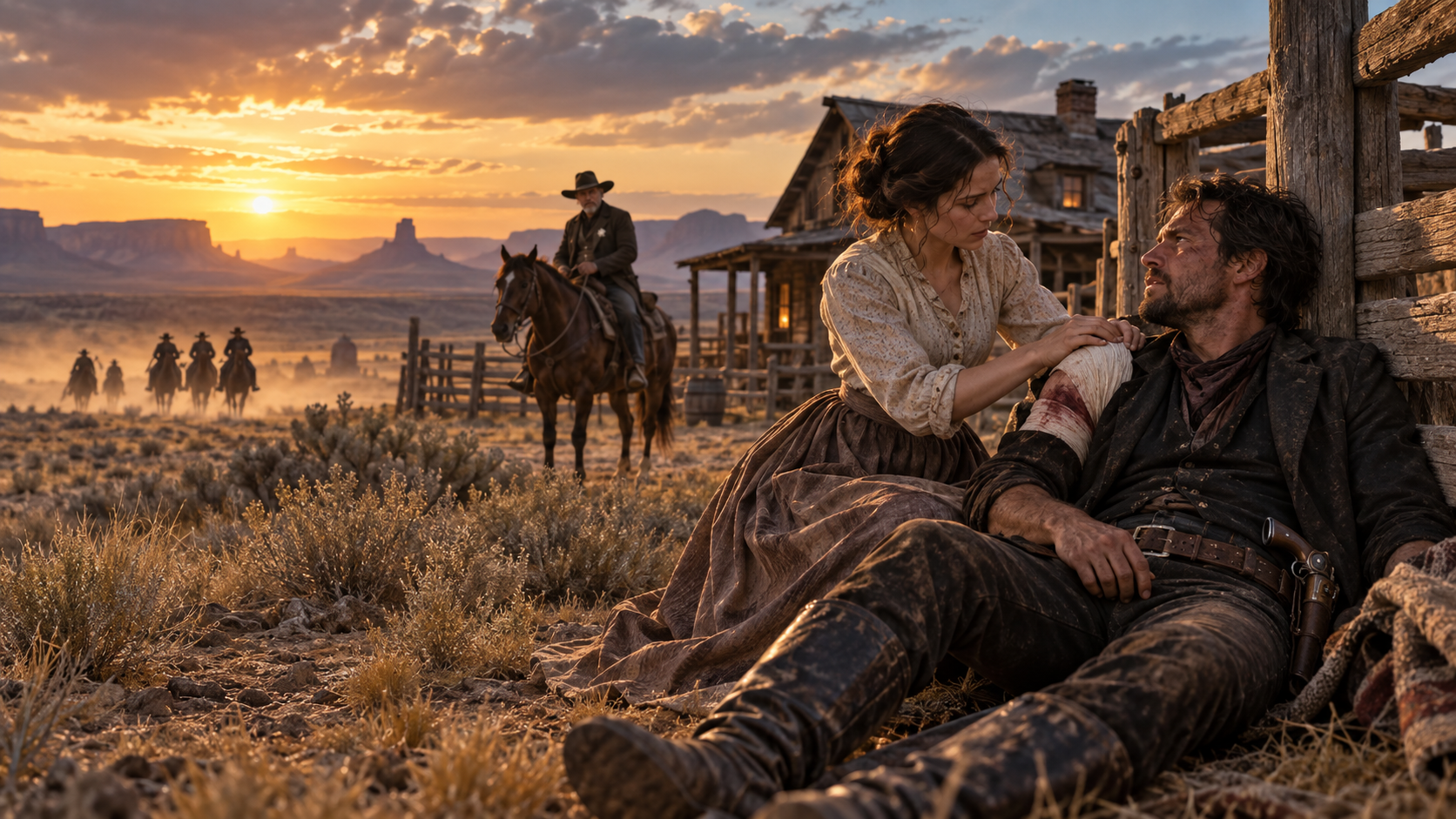
The story follows Quirt Evans, a notorious outlaw whose reputation has been built through violence. His dangerous life appears to be reaching its inevitable conclusion when he arrives on a ranch with a bullet in his back.
Quirt expects to die. Instead, he is treated with compassion by Penny, the rancher’s daughter. Her decision to care for him introduces Quirt to something he has rarely experienced: mercy offered without fear, payment, or manipulation.
As he recovers, Quirt begins to see the possibility of a different life. Penny and her family represent stability, kindness, and community—the opposite of the hostile world in which he has learned to survive. His growing connection with Penny encourages him to imagine an identity that is not defined by his gun or his reputation.
However, leaving violence behind is not as simple as making a private decision. A marshal is closing in, while Quirt’s former associates remain a dangerous threat. When an outlaw gang prepares to attack the ranch, Quirt must decide whether he can protect his new home without becoming the same merciless man he once was.
The official synopsis frames the central question clearly: what kind of man will Quirt choose to be when the world demands blood?
When Is Angel and the Badman Being Released?
Angel and the Badman is scheduled to open in U.S. theaters on October 9, 2026. The film has received a PG-13 rating for violence and bloody images, suggestive material, and language.
The theatrical release is significant because Westerns benefit from the scale of the cinema. Open landscapes, thundering horses, tense confrontations, and the silence before a gunfight can feel more powerful on a large screen. At the same time, the film’s emotional themes suggest that it will offer more than action spectacle.
International release plans may vary by country, so viewers outside the United States should check local theater listings as the release approaches.
The Cast of Angel and the Badman
The new Angel and the Badman brings together performers who are well suited to a story balancing danger, sincerity, and moral conflict.
Zachary Levi as Quirt Evans
Zachary Levi plays Quirt Evans, the wounded outlaw at the center of the story. Quirt must be convincing as both a dangerous gunman and a man capable of genuine change.
That contrast is essential. If Quirt seems too gentle from the beginning, his transformation will carry little weight. If he remains completely cold, however, the relationship between him and Penny may feel unbelievable. Levi’s task is to show the humanity beneath Quirt’s hardened exterior without making the character’s violent history disappear.
The role also gives Levi an opportunity to work in a more restrained dramatic space. Quirt is a man who has spent years hiding vulnerability because, in his world, vulnerability can get someone killed. Much of the performance may depend on small changes in behavior rather than long speeches about redemption.
Meg Fraser as Penny
Meg Fraser plays Penny, the rancher’s daughter who helps Quirt after he is wounded. Penny is not simply a romantic reward waiting at the end of the outlaw’s journey. She is the person whose compassion forces him to reconsider everything he believes about strength.
For the character to work, Penny must possess more than innocence. Caring for a dangerous stranger requires courage, conviction, and an ability to see possibilities that other people cannot. Her influence does not come from overpowering Quirt. It comes from refusing to accept that violence is the only language he understands.
The success of Angel and the Badman may depend heavily on the chemistry between Fraser and Levi. Their relationship needs to develop as an authentic encounter between two people with radically different experiences of the world.
Neal McDonough as Laredo
Neal McDonough portrays Laredo, a figure associated with Quirt’s violent past. He represents the life that continues to pursue the outlaw even after Quirt begins considering a different future.
A strong Western antagonist does more than create physical danger. He also tests the hero’s beliefs. Laredo can challenge Quirt by reminding him that mercy may be interpreted as weakness and that old enemies rarely respect a desire to change.
McDonough has the commanding presence necessary for that kind of threat. His involvement also creates the possibility of a villain who is controlled and intelligent rather than simply loud or reckless.
Tommy Lee Jones
Academy Award winner Tommy Lee Jones is one of the film’s most recognizable stars. Although early promotional information has emphasized his participation without clearly identifying his character, his presence immediately adds Western credibility.
Jones has repeatedly shown an ability to communicate authority, regret, and hard-earned wisdom with very little dialogue. In a story concerned with consequences and moral judgment, that quality could make his character especially important.
The supporting cast also includes Jean Louisa Kelly as Irene Worth, Barrett Ellis Luca as Johnny Worth, Melissa Chambers as Harriet, Maurice Greene as Tully, Jesús Carús as Hondo, and Sean Bridgers as Deputy Eli.
Julio Quintana’s Direction
Julio Quintana directs Angel and the Badman, working from a screenplay credited to Jaime Hernandez, Kevin M. Townsend, and Christopher Tuffin. Angel Studios introduced the project as a reimagining of the John Wayne classic and announced Tommy Lee Jones, Zachary Levi, and Neal McDonough as its leading stars.
Quintana’s challenge is to respect the simplicity of the premise without allowing the film to feel old-fashioned in an unintentional way. The central conflict remains powerful because it is universal: can a person escape the identity created by years of destructive choices?
A modern version can explore that question with greater psychological depth while preserving the direct storytelling associated with traditional Westerns. The landscape, costumes, action, and period details may attract audiences, but the film will ultimately depend on whether Quirt’s internal struggle feels genuine.
A New Interpretation of the 1947 Classic
The 2026 movie is based on the 1947 Angel and the Badman, written and directed by James Edward Grant. The original starred John Wayne as Quirt Evans, Gail Russell as Penelope “Penny” Worth, Harry Carey as Marshal Wistful McClintock, and Bruce Cabot as Laredo Stevens.
The American Film Institute records the original as a 100-minute Western released in February 1947. It was also the first feature produced by Wayne’s Patnel Productions and marked his first producing effort for Republic Pictures. Location work took place around Flagstaff and Sedona in Arizona, as well as Monument Valley in Utah.
The original stood apart from many Westerns of its era because its hero’s greatest challenge was not defeating another gunman. It was deciding whether violence had become inseparable from his identity.
That idea remains relevant. Modern audiences are accustomed to complicated protagonists, but stories about redemption can sometimes make change appear too easy. Angel and the Badman has the opportunity to show that transformation requires sacrifice. Quirt cannot simply announce that he has changed. He must prove it when returning to his former behavior would be easier, faster, and perhaps safer.
The new production therefore does not need to reproduce every scene or performance from the 1947 film. Its more important responsibility is to preserve the original moral tension.
Redemption Is the Heart of the Story
At first glance, Angel and the Badman has the familiar ingredients of a traditional Western: an outlaw, a determined lawman, a ranch under threat, a dangerous gang, and an approaching confrontation.
Underneath those elements is a story about whether identity can be rewritten.
Quirt has likely survived by believing that fear creates safety. If people are afraid of him, they are less likely to challenge or betray him. Penny introduces a completely different kind of strength. Her family’s willingness to help a wounded stranger suggests that courage can be expressed through compassion rather than domination.
That does not mean the story asks Quirt to become passive. The ranch is facing a real threat, and innocent people may be harmed if he refuses to act. His dilemma concerns how he acts and what motivates him.
Is he defending the family because he loves them, or is he using their danger as an excuse to return to revenge? Can he confront violent men without allowing hatred to control him? Is redemption still meaningful if he picks up a gun again?
These questions give the Western action emotional purpose. Every confrontation can become another stage in Quirt’s internal struggle.
The Importance of Penny
The “angel” in the title is commonly understood to be Penny, but reducing her to a flawless symbol would weaken the drama. The most compelling version of Penny is not someone who is unaware of danger. She understands that Quirt may bring violence into her family’s home, yet she chooses to believe that his past does not have to determine his future.
Her compassion is therefore an active decision, not naïveté.
Penny also prevents the story from presenting redemption as an individual achievement. Quirt may have to make the final choice himself, but he first needs someone to show him another way of living. Transformation often begins when a person is treated as more than the worst thing they have done.
The romance between Penny and Quirt can deepen that idea, provided the film allows trust to develop gradually. Love should not magically erase Quirt’s past. Instead, it should give him a reason to confront it honestly.
Why Westerns Still Matter
The Western genre has endured because it turns moral questions into physical landscapes. A character may stand in an open desert with nowhere to hide, just as he may reach a moment when he can no longer hide from his own choices.
Modern Westerns often examine the mythology of the heroic gunslinger. They ask whether violence truly solves problems or simply passes pain from one generation to another. Angel and the Badman is especially suited to that conversation because its hero already understands how to win a gunfight. What he does not understand is how to build a peaceful life.
The film can also explore the cost of reputation. Quirt’s name may protect him in one town and condemn him in another. Even if he sincerely wants to change, other people will continue reacting to the man they believe him to be.
That tension feels surprisingly contemporary. People are often judged by a fixed version of their identity, particularly after their failures become public. The possibility of growth may exist, but earning trust takes time.
What Audiences Can Expect
Based on the announced story and promotional material, audiences can expect a blend of Western action, romance, humor, and values-driven drama. Producer Jaime Hernandez has specifically described the film as combining redemption and personal growth with action, humor, and romance.
Viewers hoping for a traditional Western should find familiar imagery and conflicts: dusty settlements, armed outlaws, ranch life, tense standoffs, and a hero trapped between the law and criminal enemies.
Those more interested in character-driven drama may be drawn to Quirt’s relationship with Penny and his attempt to imagine a future beyond survival. The film’s PG-13 rating suggests meaningful action and darker consequences, while still positioning it for a broad audience.
Because the movie had not yet opened at the time of writing, any judgment about its final quality would be premature. Its premise and cast, however, give it the ingredients for a Western that can be both accessible and emotionally thoughtful.
Final Thoughts on Angel and the Badman
Angel and the Badman is built around a question that reaches far beyond the Western genre: can people truly change after spending years becoming someone they no longer want to be?
Quirt Evans may know how to intimidate enemies and survive a violent encounter, but Penny offers him a more difficult challenge. She asks him to believe that mercy is not weakness, that love requires responsibility, and that a man’s future does not have to be controlled by his past.
With Zachary Levi leading the cast alongside Meg Fraser, Neal McDonough, and Tommy Lee Jones, the new film has the potential to introduce this enduring story to another generation. Director Julio Quintana’s reimagining will arrive in U.S. theaters on October 9, 2026.
If it successfully balances its action with the emotional weight of Quirt’s transformation, Angel and the Badman may demonstrate why the classic Western remains such a powerful home for stories about justice, forgiveness, and second chances.