
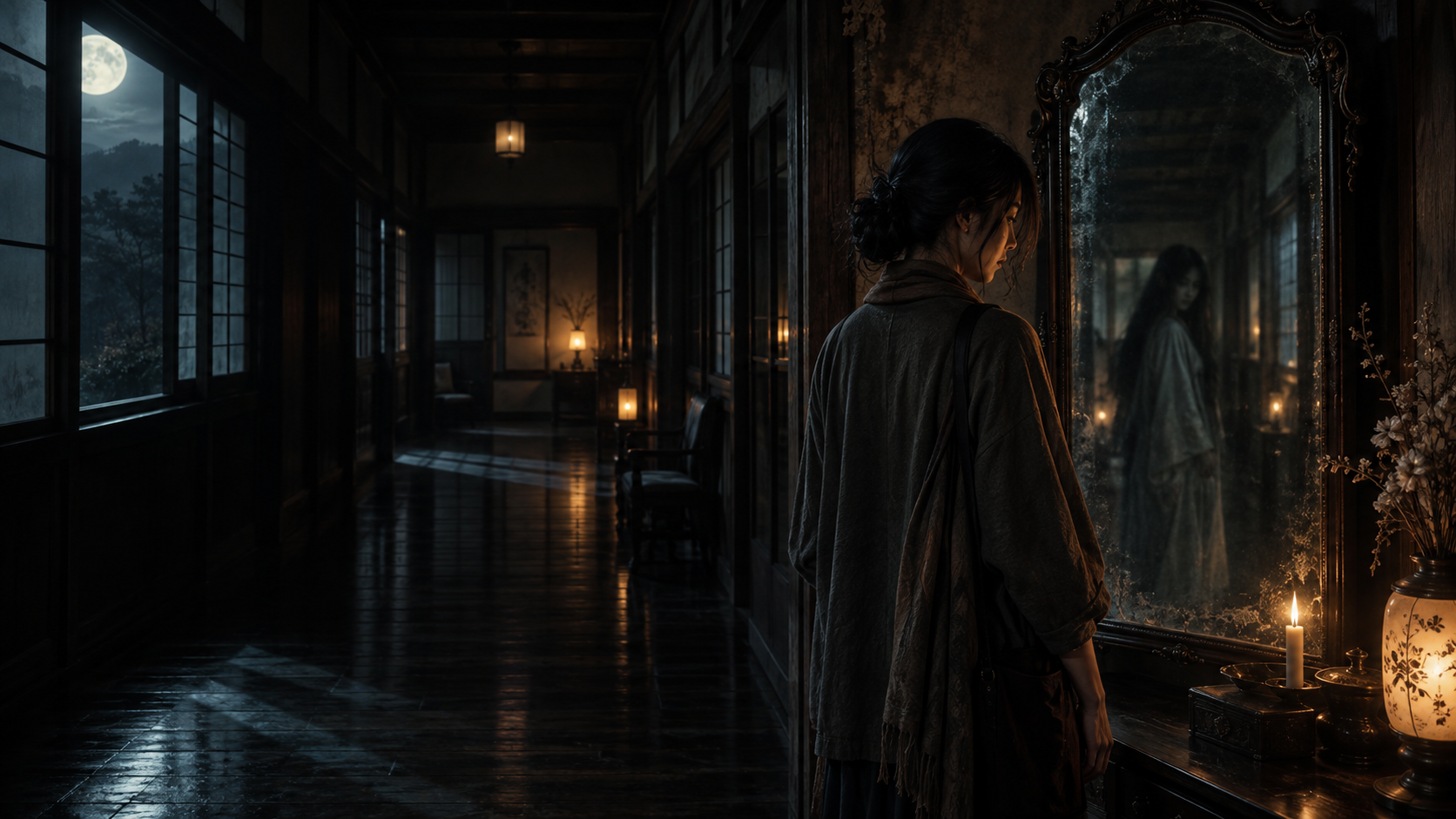
Airi has made a living helping restless spirits leave the world of the living. She knows how to approach a haunting, how to perform her rituals, and how to stay calm when other people are frightened. Then she accepts a job at an isolated house where the ghost behaves unlike anything she has encountered before.
That is the unsettling premise of Never After Dark, a Japanese horror film written and directed by Dave Boyle. Moeka Hoshi, known internationally for Shōgun, plays Airi, while Kurumi Inagaki, Kento Kaku, Tae Kimura, and Mutsuo Yoshioka help bring the mystery surrounding the house to life.
The film premiered at the 2026 South by Southwest Film & TV Festival, opened in Japan in June, and is scheduled for a U.S. theatrical release on September 25, 2026. Its haunted-house premise is familiar enough to draw viewers in, but its central question is more unsettling: What happens when someone trained to deal with the dead discovers that the living may be harder to survive?
Here is a spoiler-light guide to the story, cast, production, and release of Never After Dark.
What Is Never After Dark About?
Airi is a wandering medium who travels to help spirits move on. Her latest assignment takes her to a secluded country house, where she encounters a grotesque apparition whose powers seem to defy her experience.
As Airi investigates the property’s past, she discovers that the haunting conceals a deeper secret. The danger grows beyond the spirit she was originally called to confront, leaving her vulnerable to a threat she is less prepared to handle.
That outline comes from Magnolia Pictures’ official press notes, which describe the film’s shift from a supernatural mystery toward danger from the living. The setup gives Airi a fascinating disadvantage. She arrives as the expert, but expertise in one kind of fear cannot necessarily protect her from another.
The house itself is a former hotel converted into a private residence. Its scale gives Airi room to search, while its isolation makes every unfamiliar sound and encounter feel more threatening. The film uses that setting to ask whether Airi can trust what she sees—and whom she can trust when her usual methods stop working.
Who Is Airi?
Many horror protagonists spend the first part of a ghost story struggling to believe that spirits exist. Airi begins from a different position: communicating with them is her work.
That choice changes the tension. Airi has procedures and experience, so an ordinary haunting should be something she can investigate. Her confidence makes the entity at the remote house more alarming. If she cannot understand it, the audience has little reason to feel safe.
Moeka Hoshi plays Airi with the burden of that knowledge. Viewers of the FX series Shōgun may recognize Hoshi as Usami Fuji, though this role places her at the center of a very different story. Airi has to carry both the investigation and the emotional weight behind her work.
Director Dave Boyle has explained that he wanted to follow a professional medium in close detail: someone who knows the steps for dealing with a spirit, only to face a case that overturns her expectations. In his director’s statement, he also makes clear that Airi’s practices belong to a fictional spiritual tradition created for the film. They are part of its storytelling rather than a claim to depict a real ritual.
Why Is Airi’s Sister Miku Important?
Kurumi Inagaki plays Miku, Airi’s older sister. Their relationship gives the film an emotional connection beyond the immediate danger at the house.
Festival reviews describe Miku as a deceased sister who remains present in Airi’s life. That bond helps explain why Airi’s relationship with spirits is personal as well as professional. She is accustomed to helping strangers find peace while continuing to carry a loss of her own.
A HorrorBuzz festival review highlights the sisters’ relationship as one of the elements that grounds the film. It also notes an important limit: Miku may be close to Airi, but being a spirit restricts how much she can do when events in the physical world become dangerous.
This gives the story another source of suspense. Airi is rarely emotionally alone, yet she may still have to face the most immediate threat by herself.
Who Is in the Never After Dark Cast?
The film’s principal cast includes:
- Moeka Hoshi as Airi, the traveling medium
- Kurumi Inagaki as Miku, Airi’s older sister
- Kento Kaku as Gunji
- Tae Kimura as Teiko
- Mutsuo Yoshioka as the Gaping-Mouth Man, the disturbing figure Airi encounters
- Bokuzō Masana as Officer Inokoshi
These character names and credits are listed in Magnolia Pictures’ official cast notes. The filmmakers have kept much of the characters’ connection to the house and its history out of the basic synopsis, allowing viewers to discover the mystery with Airi.
Kaku also produced the film. He and Boyle previously worked together on Netflix’s House of Ninjas, as did several members of the Never After Dark cast and crew.
Who Directed Never After Dark?
Dave Boyle wrote and directed Never After Dark. His earlier films include the mystery Man from Reno, and he served as showrunner and lead director on House of Ninjas.
After that larger television production, Boyle and Kento Kaku wanted to make a theatrical film with a more contained setting. They developed Never After Dark through Signal181, their Tokyo-based production company. The film is the company’s first production.
Boyle wrote the screenplay in Tokyo in 2024 and worked closely with Kaku on the Japanese dialogue. Their collaboration matters to the finished film’s identity: it brings together Boyle’s interest in ghost stories with a Japanese cast, crew, location, and production process.
Boyle has described two ideas behind the movie. He wanted to show how an experienced medium approaches a haunting, then combine that ghost story with the tension of a home invasion thriller. Those intentions help explain why the film’s premise changes direction without giving away the secrets Airi discovers.
Where Was Never After Dark Filmed?
Finding the right house was a major part of the production. According to Magnolia’s press notes, the team searched for more than six months before choosing the Village III property in Kiyosato, Japan.
The building’s previous use as a hotel made it well suited to a story that needed both a private residence and an unsettling sense of scale. The production redesigned the location for the film but also incorporated features already on the property, including a small chapel and a nineteenth-century music box.
Filming was planned as a 30-day shoot beginning in April 2025. The production started from Nikkatsu Studios in Chōfu before relocating to Yamanashi Prefecture for the work at the house. It wrapped in early May.
Those details help explain why the location feels central to the story. The house gives Airi rooms to explore, a history to uncover, and a physical space where the living and the dead can seem uncomfortably close.
How Does the Film Create Its Ghostly Atmosphere?
Never After Dark uses a mixture of practical effects, lighting, makeup, and visual effects. Boyle’s team aimed to create effects in front of the camera wherever possible, using digital work to enhance them.
The filmmakers used practical lighting for changes between day and night. Mirror effects were also achieved largely in camera, while live effects on set helped create the house’s paranormal disturbances. Production designer Yuji Hayashida designed a spinning mirror device for Airi’s passage toward the spirit world.
That attention to physical detail gives Airi’s work a visual identity. She does more than speak to an unseen presence; her rituals involve an object the audience can watch and a change in the world around her.
Patrick Ouziel photographed the film, with Hidenori Nagata directing the lighting. The score is by Jonathan Snipes, and Chieko Suzaki edited the movie. Festival critics have singled out its imagery and atmosphere, including the way the camera makes the house inviting to inspect even as it becomes less safe to inhabit.
Is Never After Dark a Traditional Ghost Story?
It starts with recognizable ghost-story elements: a medium, an isolated property, an alarming apparition, and a hidden past. Airi’s experience adds a twist because she knows how most hauntings work.
The official synopsis also points to a second kind of horror involving living people. That does not erase the supernatural mystery. It raises the stakes of Airi’s investigation, since finding out what happened in the house may place her in danger beyond the haunting itself.
Early reviews have responded to that blend in different ways. RogerEbert.com’s SXSW coverage praised Boyle’s film and connected it to traditions of Japanese and South Korean horror. HorrorBuzz praised Airi, her relationship with Miku, and the film’s visual approach.
For viewers deciding whether to see it, the most useful expectation is a supernatural mystery with a changing source of danger. The released synopsis establishes that shift; the precise discoveries and ending are best left for the film.
How Was Never After Dark Received at Festivals?
Never After Dark had its world premiere at SXSW on March 13, 2026, where it screened in the Midnighter section. It won that section’s Audience Award, according to Magnolia Pictures’ press notes.
It continued to screen at genre festivals, including the Overlook Film Festival and Fantasia International Film Festival. Festival response has drawn particular attention to Hoshi’s lead performance, the effects, and the way the film develops beyond its initial haunted-house setup.
That early attention gives horror fans something more substantial than a trailer to go on, while leaving room for audiences to form their own opinions when the film reaches theaters.
When Is the Never After Dark Release Date?
Never After Dark opened theatrically in Japan in June 2026. Magnolia Pictures is scheduled to release it in the United States on September 25, 2026, as confirmed in its official production and release notes.
The film is 104 minutes long and is in Japanese. U.S. moviegoers should check local listings for screenings, since a theatrical release date does not guarantee that every cinema will carry it. A U.S. streaming date has not been confirmed in the cited release information.
What Makes Never After Dark Stand Out?
The most interesting promise of Never After Dark is its lead character. Airi knows the rules of her job, and watching those rules fail gives the audience a way into the mystery. Her bond with Miku adds grief and affection to a story that might otherwise depend entirely on the house’s frightening images.
Boyle and his collaborators also built the haunting around specific spaces and objects: a former hotel, a chapel, mirrors, a music box, and rituals designed for Airi. Those choices make the supernatural world feel connected to a place she can investigate rather than a series of random scares.
The film’s greatest threat remains part of its mystery. Airi arrives prepared to help a spirit leave. To get out of the house herself, she will have to understand why it is haunted—and recognize the danger waiting among the living.
[…] absurd effort to manage a crisis through sheer force of personality. Warner Bros. official film […]