
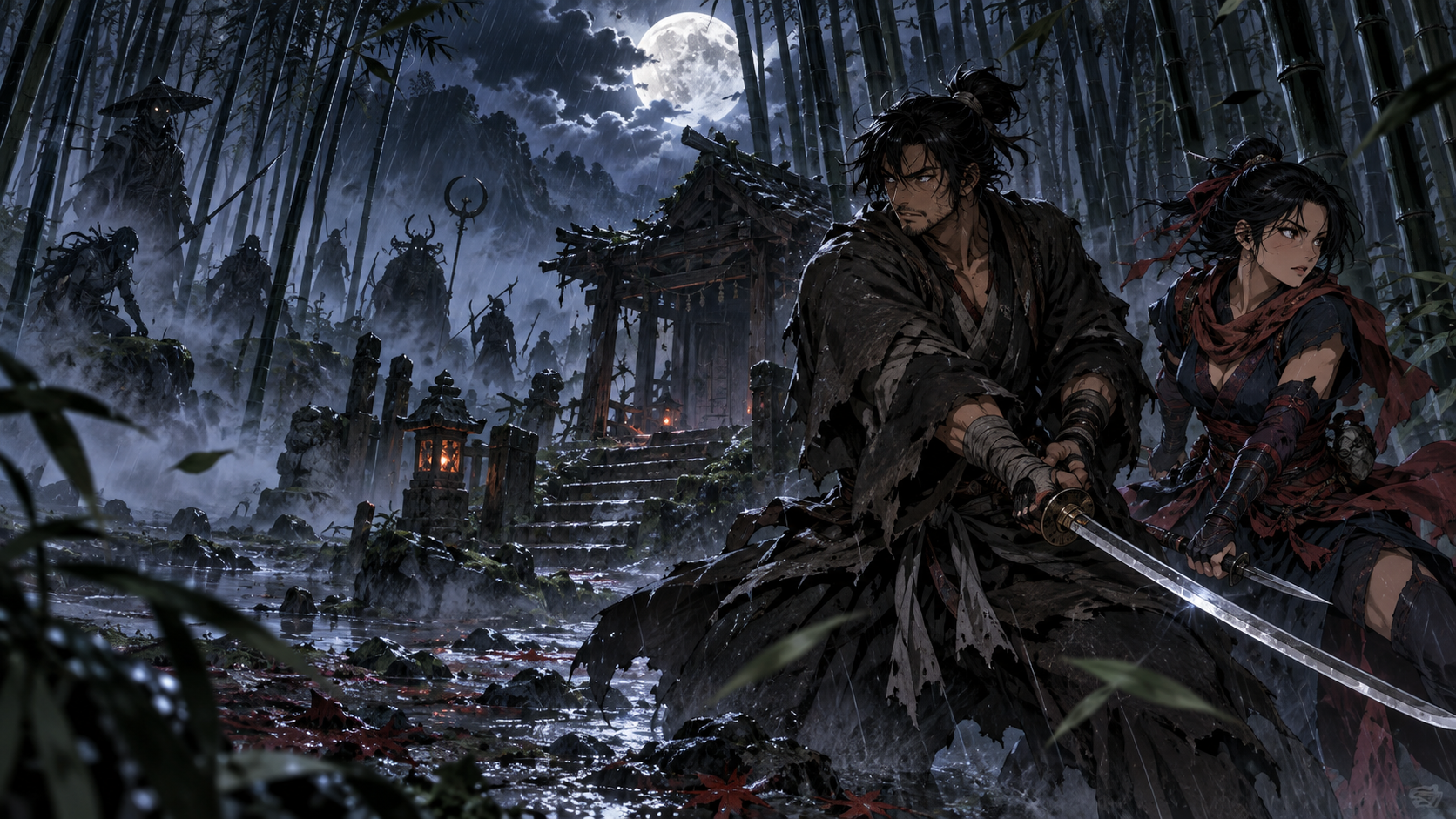
Few animated action films have built a reputation as fierce or enduring as Ninja Scroll. Released in 1993, Yoshiaki Kawajiri’s dark samurai adventure combines supernatural enemies, political conspiracy, brutal sword fights, and striking hand-drawn animation into a compact story that rarely slows down.
For many international viewers, Ninja Scroll was one of the first anime films to demonstrate that Japanese animation could offer mature storytelling far removed from children’s entertainment. Its violence, sexuality, horror, and morally complicated characters gave it a dangerous quality that made it stand out on video-store shelves during the 1990s.
More than three decades later, the film continues to attract new audiences. A restored 4K version is returning to theaters in 2026, giving fans another opportunity to experience its detailed artwork and relentless action on a large screen.
What Is Ninja Scroll About?
Set in feudal Japan, Ninja Scroll follows Jubei Kibagami, a wandering swordsman who sells his abilities when necessary but avoids serving any permanent master. Jubei is highly skilled, observant, and difficult to intimidate. Unlike the supernatural warriors he encounters, however, he remains human and vulnerable.
His journey changes when he crosses paths with Kagero, a female ninja whose team has been sent to investigate mysterious deaths in a remote village. The deaths initially appear to have been caused by a deadly plague, but the truth is much more sinister.
Jubei rescues Kagero from a terrifying attacker and soon becomes trapped in a conflict involving the Eight Devils of Kimon, a group of assassins with seemingly impossible abilities. Each Devil possesses a different physical power or specialized method of killing. One controls swarms of dangerous creatures, another manipulates shadows, while others rely on poison, explosives, electricity, or unnatural strength.
A government spy named Dakuan forces Jubei to participate in the investigation. Together, Jubei, Kagero, and Dakuan uncover a conspiracy with consequences that reach far beyond one destroyed village.
The basic plot sounds straightforward, but Ninja Scroll builds its world through fragments of information. Alliances are uncertain, powerful groups operate in secret, and nearly every character is hiding something.
Jubei Kibagami Is a Different Kind of Hero
Jubei is one of the main reasons Ninja Scroll remains memorable. He is an extraordinarily capable swordsman, but the film does not portray him as invincible.
He survives by thinking quickly and understanding his surroundings. During battle, he studies an opponent’s behavior, searches for weaknesses, and uses the environment to create an advantage. His victories feel earned because the Eight Devils of Kimon frequently overpower him during their first encounters.
Jubei also differs from the traditional hero because he is not motivated by fame, patriotism, or unquestioning loyalty. He has already experienced betrayal and understands that powerful leaders often treat ninja as disposable tools. His independence is therefore a form of self-protection.
Despite his cynical attitude, Jubei still possesses a moral center. He may claim to care only about payment or survival, but he repeatedly risks his life to help others. His choices reveal a compassionate person beneath the image of the detached wandering mercenary.
That balance makes him more interesting than a flawless warrior. Jubei is calm without being emotionless, honorable without being naïve, and powerful without losing his humanity.
Kagero Brings Tragedy to the Story
Kagero is more than Jubei’s companion. Her life shows the personal cost of the political system surrounding the characters.
As a member of a ninja clan, she has been trained to obey orders even when her leaders show little concern for her survival. Her unusual resistance to poison makes her valuable, but that same ability has isolated her from normal human relationships.
Kagero is deadly in combat, yet she is also emotionally vulnerable. She has spent much of her life being treated as an instrument rather than a person. Her interactions with Jubei gradually challenge that belief.
The relationship between Jubei and Kagero gives Ninja Scroll its emotional core. They do not immediately trust each other, and their partnership is shaped by danger rather than romantic fantasy. As they continue fighting together, respect develops between them.
Kagero’s story also prevents the film from becoming a simple sequence of stylish battles. Her loneliness and determination give the violence emotional consequences. Every victory matters because the audience understands what she has already sacrificed.
The Eight Devils of Kimon
The villains of Ninja Scroll are among the most distinctive collections of antagonists in anime history. The Eight Devils of Kimon function almost like a series of increasingly difficult challenges, but they are more than video-game-style opponents.
Each Devil has a memorable silhouette, personality, and combat technique. Their abilities transform every confrontation into a different kind of puzzle. Jubei cannot defeat all of them through swordsmanship alone. He must adapt his strategy depending on whether he is fighting in a forest, a ruined building, an open field, or aboard a ship.
This structure gives the film remarkable momentum. A new threat can appear at almost any moment, but the battles rarely feel identical. One sequence may emphasize speed, while another becomes a test of patience, deception, or environmental awareness.
The Devils are led by Genma Himuro, a figure connected to Jubei’s past. Genma is more than a physically intimidating enemy. He represents betrayal, corruption, and the kind of power that treats human life as an expendable resource.
His presence makes the larger conspiracy personal. Jubei is not merely interfering with an unfamiliar group of assassins. He is confronting the consequences of a history he believed he had escaped.
Yoshiaki Kawajiri’s Distinctive Direction
Ninja Scroll was written and directed by Yoshiaki Kawajiri, with character design and animation direction by Yutaka Minowa, art direction by Hiromasa Ogura, and music by Kaoru Wada. The film runs approximately 94 minutes.
Kawajiri’s direction is notable for its clarity. The action can be extremely fast, but viewers generally understand where the characters are positioned and how one movement leads to another.
Rather than filling the screen with constant visual noise, Kawajiri frequently uses stillness to build anticipation. Leaves move in the wind. A character waits in darkness. A weapon is revealed for only a moment. Then the scene explodes into violence.
This control of rhythm makes the fights feel dangerous. The audience is not simply waiting for an attack to end. Every pause suggests that another threat may be hiding just outside the frame.
Kawajiri also uses weather as part of the drama. Rain, fog, wind, and oppressive heat shape the mood of individual sequences. Nature never feels like a decorative background. It becomes part of the danger surrounding the characters.
Hand-Drawn Animation That Still Feels Powerful
One of the greatest strengths of Ninja Scroll is its hand-drawn animation. The characters have weight, and their physical movements communicate effort. When someone leaps, falls, swings a sword, or collides with a wall, the impact feels tangible.
The film’s color palette contributes to its atmosphere. Deep blues, violent reds, sickly greens, and shadowed earth tones create a world that feels both historical and supernatural.
Background art is equally important. Forests appear dense and threatening. Villages feel abandoned rather than empty. Interior spaces are defined by narrow corridors, paper walls, wooden beams, and pockets of darkness where enemies might be waiting.
The animation is also willing to become grotesque. The Eight Devils possess abilities that distort the human body, allowing the film to move between samurai action and body horror. These images can be disturbing, but they establish that Jubei has entered a conflict governed by forces beyond normal human experience.
Action With Purpose
The violence in Ninja Scroll is extreme, but its best action sequences are not violent merely for spectacle. They reveal character.
Jubei’s movements show his intelligence and adaptability. Kagero’s fighting style reflects discipline and emotional control. The Devils fight according to their arrogance, appetites, or obsessions. Even minor decisions made during combat communicate something about the person holding the weapon.
The battles also advance the mystery. Jubei learns about the conspiracy by surviving encounters with its agents. Information and action are therefore connected rather than divided into separate sections.
This efficiency helps the film fit a surprisingly large story into its short running time. Exposition is often delivered during pursuit, investigation, or confrontation, allowing the narrative to keep moving.
Themes of Freedom, Loyalty, and Exploitation
Beneath its supernatural action, Ninja Scroll is deeply concerned with control.
Many of its characters belong to clans, government organizations, or secret groups that demand complete obedience. Ninja are valued for what they can accomplish, but their personal desires are considered unimportant.
Jubei’s status as a wandering swordsman gives him freedom, yet it also leaves him isolated. Kagero has a clan and a defined purpose, but she lacks control over her own life. Dakuan serves political interests while manipulating everyone around him.
The film repeatedly asks whether loyalty is meaningful when it is created through fear, duty, or deception.
Another major theme is the difference between physical power and genuine strength. The Eight Devils possess abilities that make them appear nearly unstoppable, but their cruelty and arrogance frequently become weaknesses. Jubei survives not because he is the strongest person in every battle, but because he remains adaptable and capable of caring about other people.
Mature Content and Viewer Expectations
Ninja Scroll was created for mature audiences. It includes graphic violence, blood, nudity, sexual material, and scenes involving sexual assault. Some sequences can be especially uncomfortable, even for viewers accustomed to violent anime.
These elements are part of the film’s reputation, but potential viewers should know about them before watching. This is not a family-oriented samurai adventure.
Some aspects of the movie may also feel dated. Female characters are sometimes placed in exploitative situations, and the film occasionally uses sexualized violence in ways that modern audiences may question.
Recognizing those issues does not erase the film’s artistic achievements. It simply allows viewers to approach Ninja Scroll with a fuller understanding of both its strengths and its more controversial choices.
Why Ninja Scroll Became a Gateway Anime
During the 1990s, international access to anime was much more limited than it is today. Viewers frequently discovered Japanese animation through imported tapes, specialized retailers, late-night television, conventions, and recommendations from friends.
Ninja Scroll became one of the titles that changed Western perceptions of the medium. Alongside movies such as Akira and Ghost in the Shell, it demonstrated that animation could tell mature, visually sophisticated stories for adults.
Its appeal was immediate. The narrative was accessible without requiring knowledge of a long television series, the action crossed language barriers, and the supernatural villains created unforgettable images.
Japan Society has described the film as an essential work that opened the minds of animators and filmmakers in Japan and the United States to the possibilities of animation.
The English-dubbed release also helped the movie reach viewers who might not otherwise have explored subtitled anime. For an entire generation, Ninja Scroll was not simply another animated film. It was evidence that animation could be darker, stranger, and more cinematic than they had imagined.
The 2026 Ninja Scroll 4K Restoration
Interest in Ninja Scroll remains strong enough to bring the film back to theaters more than 30 years after its original release.
The new restoration was produced by Sentai under Yoshiaki Kawajiri’s supervision. The process involved scanning the original 35mm negative at 3840 × 2160 resolution, repairing physical damage, and completing new color correction to create an archival-quality digital master. The restored version received its world premiere at the 76th Berlin International Film Festival.
The 4K restoration is scheduled to screen in selected theaters across the United States and Canada on October 4, 5, and 7, 2026. Australian and New Zealand screenings begin on October 8, with the film presented in Japanese with English subtitles.
The restoration is more than a resolution upgrade. Because Ninja Scroll was created through traditional animation, a high-quality scan can reveal the texture of painted backgrounds, the precision of inked lines, and subtle details that older home-video editions may have obscured.
The theatrical presentation may also restore a sense of scale to the movie. Its forests, castles, storms, and battles were designed as cinematic images, and a large screen can make their atmosphere more immersive.
Does Ninja Scroll Still Hold Up?
In many ways, yes.
The animation remains expressive, the action direction is exceptionally clear, and the Eight Devils of Kimon are still memorable villains. Jubei and Kagero give the story enough humanity to prevent it from becoming an empty exercise in violence.
Its concise structure is another advantage. The film introduces an entire supernatural world, develops its central characters, delivers numerous distinctive battles, and completes its main story in approximately an hour and a half.
Not every element has aged equally well. Its treatment of sexual violence deserves criticism, and viewers may find some character development too limited. Yet the movie’s visual craftsmanship and influence are difficult to dismiss.
Final Thoughts
Ninja Scroll remains a landmark of adult animation because it combines extraordinary style with disciplined storytelling. Its supernatural battles are imaginative, but its lasting power comes from the human struggle beneath them.
Jubei wants freedom from his past. Kagero wants to be valued as a person rather than a weapon. Both are surrounded by organizations that view loyalty, bodies, and lives as resources to be used.
Yoshiaki Kawajiri transforms that conflict into a fast, atmospheric samurai thriller filled with memorable imagery and carefully constructed action. The result is violent, flawed, beautiful, and unmistakably influential.
The 2026 4K restoration offers longtime fans a chance to rediscover its visual detail while introducing a new generation to one of the defining anime films of the 1990s. More than three decades after its debut, Ninja Scroll has lost none of its ability to surprise, unsettle, and excite.
[…] decades after its release, Pan’s Labyrinth remains one of Guillermo del Toro’s most celebrated films. Its monsters have become cinematic icons, but its real power comes from the way it asks viewers to […]
[…] film is based on the real experiences of Gavin Bain and Billy Boyd, who met while studying in Dundee and […]
[…] movie is adapted from Incidents Around the House, Josh Malerman’s 2024 horror […]